In Defense of Common Life
It has been a while now since I escaped from school, and I feel fine. Having the right to build a life somewhere else is already a great piece of luck. A few days ago my co-supervisor, Lu Mingjun, forwarded me a Xiaohongshu post: "Doing a PhD is like entering a brothel. What we should be doing is buying our freedom as fast as we can, not competing to become the top courtesan." (http://xhslink.com/o/78IXiEXOqjc) It was such a funny way of putting it that I couldn't help sending it on to my friends right away. As it happens, in the second of the lectures collected in Analytical Psychology: Its Theory and Practice, the chairman, Dr. J. A. Hadfield, also said something rather amusing:
I am never so persuaded of the truth of any concept as when the person who proposed it is able to treat it as a subject for humor, and that is just what Professor Jung did last night. A man who is too serious about the subject he studies often betrays his anxiety and uncertainty about the truth he is so strenuously trying to promote.
When I got to that last sentence, a whole series of group portraits rose up in my mind. Humor is not the same thing as getting a laugh. Humor is a capacity for keeping things whole, a wholeness in which opposites are not only transcended but also joined together, and in which no internal contradiction turns too quickly into an either/or split. This may also be why, in the first lecture, Jung could so easily describe the thinking type as someone troubled by feelings as old as time, to the point that the description took on a teasing tone. A person with a sense of humor can, whatever they face, go deep into it and also stand outside it.
In a field that we might, for want of a better term, call the "humanities and social sciences," a person without humor often takes on the posture of a defender of the faith toward their work. They are quick to notice every sign of crisis, anxious about how sharply the boundaries of their discipline are drawn, and afraid that something beyond their understanding will dissolve those boundaries, so that they will no longer be able to live comfortably inside them. If they study philosophy or literature, they look at everything around them through a purely philosophical or literary lens. If they are well versed in scholarship, they hold Xiang Biao and Žižek to the standard of scholarly purity. The pursuit of scholarly purity is an addiction. It gives those who pursue it a secure boundary from which to pass judgment on others, but it does not necessarily help solve the pressing problems that scholarship is supposed to be about. This is a competitive model, and, in a different sense, another way of competing to be the top courtesan. Not long ago, Xie Jing said something that stayed with me:
I don't think philosophy is a matter of filling in the categories of knowledge, nor is it the most profound and abstract kind of thinking. The modern academic industry often asks scholars to compete over whose views are most original and whose expression is most refined. But for me, what matters most in thought is not novelty but whether it can really grasp and express the problems of the "we" who live in the present and live together. Becoming a feminist convinced me that thought should be connected to living life and to life itself.
In other words, even if the humanities and social sciences really are in some kind of crisis, stepping forward with great solemnity to defend the humanities, and justifying them by appeal to all sorts of lofty values, will only make them die faster. The problems of the humanities were not caused by the loss of lofty values. A person can pour boundless passion into their scholarly work and regard it as the supreme salvation of their life, but if they keep using it to make demands on other people's attitudes, that can only be seen as a kind of self-gratification.

The seemingly profound thinking of the humanities and social sciences sometimes gives people an illusion: that I am grasping the truth about how the world works in a non-instrumental way. The view that philosophy students are "smarter" than students in other humanities fields is also common enough. But someone who can deftly explain "formal purposiveness" is not necessarily a match for their own parents when it comes to understanding and getting a grip on the lifeworld. Some of the seemingly subtle ideas in the history of thought have not only done humanity no good but have brought it grave disasters. For some people, the pursuit of seriousness has reached the point where they regard short videos, algorithms, and AI as monsters, as if letting Douyin and Kuaishou take over our lives were the same as giving up humanity's noble intellect and its capacity for deep thought, so that over time we will fall into an "information cocoon" and shut ourselves off. But the ones who have really shut themselves off here are precisely the critics. In what era of history has the number of literate readers matched today's? When have we ever had access to cultural products as broad and as deep as we do now? When Kant's Critique of Judgment was published in 1790, the first printing was only 1,000 copies; when Hegel's Phenomenology of Spirit was published in 1807, the first printing was only 750. The Chinese editions of these two great works have long since far exceeded those numbers, to say nothing of the number of people who have heard of or read Kant and Hegel. A person can perfectly well know the Critique of Judgment and also take endless delight in Xiaohongshu or Douyin. People without a sense of humor tend to see these as opposed and contradictory, but that is not how real life is. There has never been an era in which we, in our everyday lives, all spent our days thinking about ultimate questions the way Kant did. And besides, even Kant had to eat and go to the bathroom. Not everyone has to prove themselves and complete their lives through "deep thinking," because the complexity and variety of everyday life itself does not exclude any way of entering it, and it also refuses to raise any one of those ways to the status of the highest or the superior one. In every era, the people who read the Phenomenology of Spirit have always been a minority, and we should be glad that they always will be. When someone, after a whole day of hard work, gets home and sinks into a rare moment of relaxation, and is then scolded for drinking "the opiate of capital" and told to uninstall Douyin at once and do some "deep thinking"; or even when, with no one scolding them, they grow wary of themselves while enjoying it and feel they are degenerating, then what kind of life, exactly, are we defending?
Moreover, algorithms do of course have problems with the values built into them (since all training is people training machines), but modern algorithms are based on neural networks and generate recommendations through "recall + ranking" precisely in order to avoid the "information cocoon." In the era before algorithms, we could only receive uniformly distributed content; personalization is actually a result of technological development. A good algorithm will, on its own, avoid pushing content that fits a single fixed preference for too long, which is why algorithms today all deliberately recommend some content outside the user's range of interests, in order to keep their own ecosystem diverse. This is not to say that the drawbacks of algorithms are all the users' fault, since the algorithm's blind spots can also lead to something like this: I turn to a platform because I am sensitive about my own symptoms, only to be shown more people with the same symptoms, so that I sink even deeper into my symptoms and cannot get out. What I want to say is that the judgments humanities scholars pass on the present state of society sometimes reveal an extreme reductionist tendency, so extreme that it actually runs against the requirements of the critical theory and other methods they rely on, as if, when it comes to modern technology, one could not display one's humanistic spirit without condemning it wholesale.
In some situations, a diagnostic method put forward and written up by Horkheimer and others, which we call "critical theory," seems to have become the cure for our times. Nowadays anyone can talk about how "alienation" and "instrumental reason" damage human subjectivity. But one of the essential points of critical theory is "immanent critique." Immanent critique does not mean pulling yourself out of present reality and fitting it into some framework of knowledge. It means letting theory (a way of grasping the object itself and of entering into a relationship with it) be embedded in the social reality one actually lives in, while staying sensitive to one's own standpoint and position. On the surface, critical theory aims at a grasp of reality as a totality, but what this really demands is an interdisciplinary way of working, that is, staying free to move among the various disciplines that can shed light on the concrete totality. I think of a line from Adorno: "One must have tradition in oneself, to hate it properly." Improper hatred comes from pure opposition and a refusal made from the outside, and it is also a humorless hatred. Such hatred is actually incapable of grasping the totality it claims to grasp.
Interestingly, Richard Rorty once had some harsh words for Heidegger, and the target of this criticism can be extended beyond Heidegger:
We need to remember that Heidegger's imagination, wide-ranging as it was, was largely confined to philosophy and lyric poetry, to the writings of those people on whom he conferred the titles of "thinker" and "poet." Heidegger believed that the essence of an epoch could be discovered by reading the work of that epoch's representative philosopher and making out his "understanding of Being." He thought that the best way to understand the history of the West was to discover a dialectical progression linking the great philosophical thinkers of the successive epochs. Those of us who teach philosophy are especially apt to be moved by the persuasiveness of Heidegger's account of the history and prospects of the West. But this susceptibility is a professional deformation that we should try to overcome.
The implication is that Heidegger was diagnosing the lifeworld by relying only on the small, serious plot of ground he had been trained in, and that we "insiders" also tend to have a superstitious faith in this sort of approach, but that this is nowhere near enough to account for how things really are. As we already know, what this approach brought was not an illumination of the lifeworld; once it entered the field of political practice, it became an accomplice of fascism. From another angle, when we talk about the "history of thought" of some past era, how much of the thought in it actually had an effect on the whole lifeworld of its time? No wonder Ge Zhaoguang argued many years ago that we should study the history of "general knowledge, thought, and belief" rather than the history of "thinkers."

A few days ago I went to hear Wang Min'an lecture on eros, and when I got back I came across an article written in a rather grim posture, titled "Wang Min'an, You Call This Modern Thought?" I have no intention of judging the article's arguments, because when someone is so fixated on using the clarity of their own discipline to purge whatever parts they consider impure, that already tells you a lot. The need for purity is not only an academic matter. Purity is at bottom a religious concept. What is impure is a desecration, something that may provoke the wrath of the Most High. After the arrival of modern society, the search for purity did not die out with the decline of religious life; on the contrary, it became more radical. The French Revolution was a key moment in the secularization of purity. Anyone who has read Danton's Death should feel this deeply. Moral purity took the place of religious monotheism, except that the heretics of old had now become counterrevolutionaries; the contaminant was still regarded as a heresy that urgently had to be purged. In the search for purity, all one finds is a despotic answer. In the end this pursuit of purity actually turns into correctness, a correctness that equates tolerance with weakness and ambiguity with retreat. But even Heidegger would admit that truth is not the same as correctness (see "The Question Concerning Technology"). While other scholars were shouting about postmodern critique, power, and desire, Wang Min'an, who had long since written about all of these, was instead standing off to one side sketching out "On the Washing Machine," "On the Television," "On the Refrigerator." If our obsession with a pure intellect has left us unable to see a living individual any longer, and makes us prefer to first stamp them with an identity like "scholar" or "Foucault scholar," then what exactly has such an intellect done for us?
That day, in his talk on eros, Wang Min'an started from Hegel's view of love as grounded in "recognition," moved on to Lacan's "love is giving what you lack to someone who doesn't want it," then went through Levinas on the caress and alterity, and closed with Badiou's "love is communism in its smallest unit." Although I thought the whole line of argument risked sliding back into the (reciprocal) economic model he was arguing against, and I was a bit disappointed that he did not get to Levinas's problem with gender, for an autumn afternoon when the weather had just turned nice, this really didn't matter much. When he was asked questions like "What do you think of the open relationship between Sartre and Beauvoir?" or "Why have dating apps made young people today incapable of love?", he spoke candidly about not caring and not understanding. For my part, though, if there really is such a thing as an "incapacity for love," it is not caused by dating apps. That seems more like a convenient excuse, one that lets people shift the work of reflecting on and building love over to a critique of technology and economics. I also threw Mr. Wang a somewhat odd question: how could a view of eros like Lacan's, based on "organic lack," account for same-sex pleasure, which does not presuppose "having the sexual organ I lack"? The lecture hall immediately filled with a cheerful atmosphere. Mr. Wang said that this just showed that Lacan's ideas really were a framework built around the male. These moments of not understanding, or of insensitivity to questions of gender, should not be treated as a person's fault, because care for the other does not show itself in the views a person professes. Think of Levinas, who raised the other to an infinite height, yet in his own life was a man who would also curse at the people around him. As director of the École normale israélite orientale, he would fly into a rage when students skipped prayers, and get so angry when students were late that he had trouble breathing. Levinas's students, his daughter, and his grandchildren almost all regarded him as a tender man who nonetheless lacked restraint and was quick to anger. Once, at a conference on his work, after a scholar finished presenting a reading of his writings, Levinas flew into a rage and walked out. Severity and tenderness did not form two split sides in him. He remembered the name of every one of his students. When his granddaughter burst into hurt tears because she was about to lose a ping-pong game to him, Levinas quietly let her have the point, to protect her small happiness. Loving others is a problem that cannot be completely philosophized, because clarity does not always bring protection.
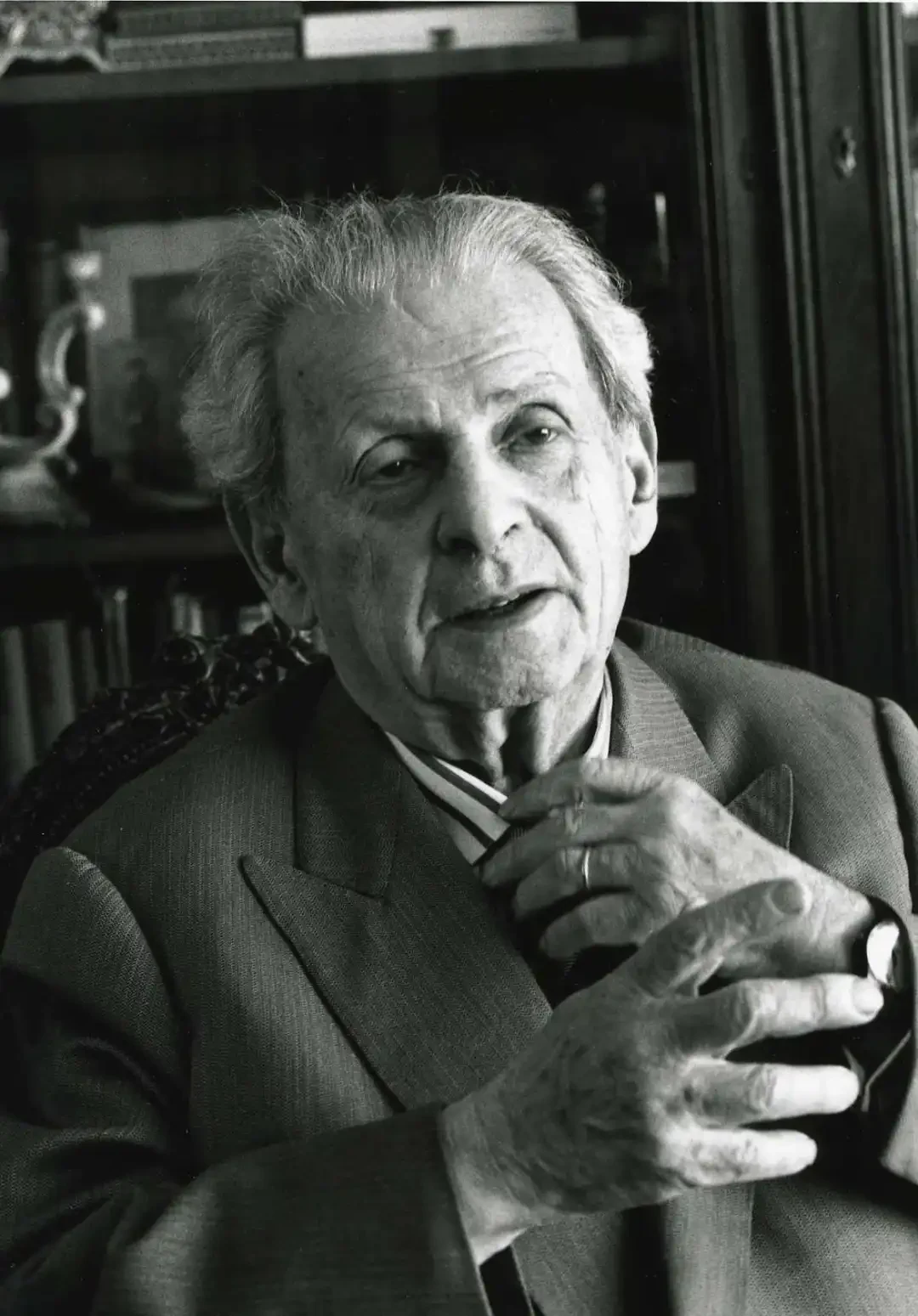
That day Mr. Wang, borrowing Hegel's words, said that "I love you" can be seen as a form of recognition, namely "I recognize your worth," for the sake of which we each sublate our own particularity, enter the other's consciousness, and achieve absolute mutual recognition. Yet however absolute this recognition, however exalted this worth, it still seems very close to a recognition that develops out of "the One" and "interiority." What is the standard of recognition? Seen this way, "loving others" seems in the end to come back to "self-love." This was also one of Wang Min'an's conclusions that day. To me, though, a love that takes recognition and fusion as its necessary conditions is not really constructive, because it still belongs to an economics of reciprocity. Although on the surface "giving up the self" and "absolute mutual devotion" look like the choices most at odds with economics, as long as we are still seeking, in such a relationship, the final closing of the gap between two absolutely different subjects, it is hard to shake off the Hegelian coloring. The recognition within love is not a recognition of the other's worth. For Luce Irigaray, this recognition is "I recognize that I can never become you," whether in body or in thought. She therefore rewrote "I love you" as "I love to (à) you." The distance that this "to" maintains is not estrangement or emptiness but a space in which interiority can pass over into exteriority. Love thus escapes blind passion and becomes a sustained, long-term promise and practice formed on the basis of difference. What "I love to you" builds is a "we" in the true sense, not an identity in which one side dissolves into the other. "We" is not an undifferentiated first person. "We" is a communist alliance made up of two third persons. Nor does this mean in the least that the arising of love leaves the stable subjectivity of the self undisturbed. In other words, a self-love that rests comfortably in self-identity can never be the substance of loving others. For Marion, love, as a purely given experience, has its assurance originate in a question: "Does anyone love me, out there?" Because love is so radical a form of otherness: it breaks in from outside, crossing my existing boundaries, and wakes me from the lonely dream of identity. Love originates in a gap that the intrusion of the other (that is, "out there") opens up within me. It is this gap that makes me a stranger to myself. It is this gap that allows me to open myself to the other, and that rules out, at the root, the possibility of "self-love." For the self cannot be its own "out there." The isolated self can, in a solipsistic way, establish that the external world exists, but it cannot answer a mocking question: "What's the point?" Just as Descartes in the end still had to appeal to God, the self cannot gain ultimate meaning from its own existence alone; this is the self's futile fate. A love capable of withstanding this futility must already lie beyond my understanding and measure; it must be transgressive (it must go beyond my limits). Otherwise, a love that I could fully control would itself be futile. The self cannot bestow such a transgressive love on itself, any more than a person can lift himself up by his own hair. The distance the other opens within me is entirely different from the distance I open within myself between the transcendental self and the empirical self. The latter can be set up as I please and crossed at any time; it cannot be the "out there" that the emergence of love requires. Self-love uses the self's internal operations to solve a problem caused by the self's own limitations. A self-loving way of loving others, then, is really an exposure of one's own incapacity.
When it comes down to it, reciprocity and exchange are at bottom compromises. However absolute such mutual recognition may be, it is still based on calculation, not love. Love is a gift of a particular kind: it arrives as a present. The perfection of a gift lies in the giving itself; even a gift that is refused loses nothing of its perfection as a gift.
Love itself is a risk. The bond between one self and another can only be realized through such a risk. It may look as if I have been too earnest in this discussion of "love," as if I have strayed too far from the "common life" of my title. But I am only trying to explain what I think about these topics in the most economical way I can, since an argument that is to be effective cannot give up normative demands. Besides, common life does not reject seriousness, nor does it reject any rigorous and earnest thinking. To live a common life means exercising a capacity to move easily through every field. It allows us to suspend, for a while, the habits that keep the self fixed in place; it lets us become aware of the effects of our various situations and positions; and it lets us step back again and again and keep a reflective stance toward ourselves. Only by withdrawing from the despotism of the self can we enter the world anew. To live such a common life is also to leave the self exposed, to let it be washed over by risk. For the so-called lifeworld is never something fixed and unchanging; it is always a world that we must encounter again each time with new eyes, and immerse ourselves in. Living a common life with humor is a better way of enriching one's understanding of the world than simple contemplation. That is because it means stepping out of the single, self-centered way of understanding, stepping out of the state Richard Rorty describes: "a person who is content with the vocabulary that determines his own actions, and sees no need to find out what vocabularies other people use, vocabularies that, as those people see it, show that what they do, which is regarded as wrong, is in fact justified."
In common life, specialized knowledge and skills go on growing. As in the metaphor Lefebvre once used, everyday life may be what is "left over" from specialized life, but it is the soil, and the specialized skills are the plants that grow out of it; these plants also rot and return to the soil, and help bring forth new flowers. What common life asks for is a way of looking that, faced with any person or any thing, is aware that a wholeness is there, and that allows anything one does not yet understand to happen. Restoring the strangeness of the world and of other people matters. Only in that strangeness is there depth. Last night, watching Palace of Desire, I kept marveling at everything about the show; its dialogue has very nearly captured the essence of Shakespeare's "lyrical irony." I wrote down one line in my notes app, something Crown Prince Hong says to Hehuan on his deathbed:
"If we are not the ones who bring sin to fruition, we are at least the gloomy keepers of its tombs!"