Academic Language and Everyday Language
I'm about to graduate. In the few years I have spent dealing with the (philosophical) "academic world," certain impressions have grown steadily sharper. In fact, from the moment I first found myself in academic settings several years ago, I noticed that I had a hard time following some "academic presentations," and over time I came to avoid lectures almost entirely. At first I wondered whether my powers of comprehension were simply not up to it, and whether that was why I couldn't follow the precise arguments of the speaker at the podium. But then I noticed that there were always some people whose lectures I listened to with real relish (for example, those of teachers like Chen Jiaying, Cheng Lesong, Shen Yubing, Qiu Xiaolin, Zhang Shuangli, and Yuk Hui), and yet hardly anyone says that these people, because they speak clearly, don't have much to think with. So speaking clearly and accessibly has no necessary connection with the complexity of one's thought. And the people who, standing at the podium, speak in an airtight way, piling clause upon clause, don't talk like that at all in ordinary life. Their Q&A sessions and their formal presentations seem to use two different languages. The first sounds just like everyday conversation, while the second is something close to a spoken version of written prose.
Under these circumstances, standing up and saying "I can't follow you" is, I think, mostly a remark about how the content is being conveyed. We seem to share a tacit understanding about academic communication: if a passage comes from a qualified scholar, we assume by default that there is real substance behind it, and that any difficulty in interpreting it is due to the complexity of the thought itself rather than to a problem in how it is conveyed. So when someone stands up and says, "I have all the background knowledge needed to understand what you're talking about; it's just that the way you're saying it makes it very hard for me to keep up in real time," the other party can reply, "If you really understood, you'd be able to keep up." That reply is not entirely without merit, but it also means that responsibility for a failure of communication always lies with the receiving end, and any request for clarity turns into a self-exposure of one's own inadequacy.
As for why so many people are inclined to talk about problems in a non-everyday way, I think it really does come down to the incentives created by the setting of the academic presentation, and indeed by the whole institution. An academic presentation is not everyday communication; there is no immediate feedback about whether one is being understood, and so the safest strategy is to read aloud what one has written. A written text has at least been revised again and again and is logically consistent. A speaker doesn't know whether the audience can keep up, but at least every sentence they say will stand up to scrutiny afterward. The cost of this behavior, though, is enormous: a piece of academic exposition that is perfectly adequate on paper becomes, once read aloud, a stream of speech that the listener can neither pause nor rewind. And in the academic culture of the humanities and social sciences, the academic presentation does not actually function entirely as a way of "making people understand." It is at the same time a kind of self-certification: a way of proving to one's peers that I really know this literature, that I can handle these theoretical discourses, and these are things that are very hard to convey in everyday speech, because speech naturally doesn't look like scholarship. If someone's presentation sounds too much like chatting, their peers may think they aren't rigorous; if it sounds too much like a paper, the audience won't be able to keep up. In hedging their bets, many people choose to avoid the first risk, because the consequences of peer evaluation are very real, while the consequences of the audience not understanding usually don't matter so much. Seen this way, a presentation that explains deep things in simple terms will not necessarily be welcome in many settings (especially those aimed at the general public). For the basis on which an audience evaluates a lecture is sometimes "what I felt," rather than "what this person actually said." A stretch of extremely dense content, full of nested jargon and complicated subordinate clauses, is almost impossible for listeners to decode fully and immediately as it streams past in real time. But the experience of failing to decode it is precisely what serves as evidence that the content is profound. The reason, again, is the tacit understanding within the academic community I mentioned earlier: I didn't understand, but this person spoke so fluently and confidently, so it must be that I'm not well enough prepared. This experience of failure is converted into a kind of self-satisfaction: I am drawing near to something higher than myself. Whereas if every sentence a speaker says can be understood, the audience never gets the chance to experience that sublime sense of being swamped by knowledge. Someone experiences a failure to decode, and therefore praises the speaker's content as wonderfully illuminating, and this works as a positive incentive for everyone, above all for the audience members themselves: by sensing depth, they prove that they are the sort of people capable of taking in such lofty academic lectures. The only problem is that there is no causal connection between all this and how much information is actually conveyed.
Speaking clearly and transparently is not easy, and its costs are obvious: getting every sentence to land exactly where the listener can receive it requires a strong command of language and a great deal of attention to other people, and the peculiar thing about this kind of attention is that the better it works, the more it seems not to be there at all. Someone who can lay out a problem clearly ought to sound the way Chen Jiaying does when he speaks, as if he were just chatting. Chatting, by a kind of tacit agreement, stands in a natural tension with "the academic." For the process by which most people receive academic training is a process of moving step by step away from everyday language. From undergraduate to master's to doctoral study, the jargon in one's vocabulary keeps growing, and this is experienced as a path of ascent. And so depth of thought gets conflated with complexity of language. This equation is very hard to put fully to the test. The humanities are unlike the sciences and engineering: the only tool the former can really rely on is language. And this language has always been the very same language we use every day.
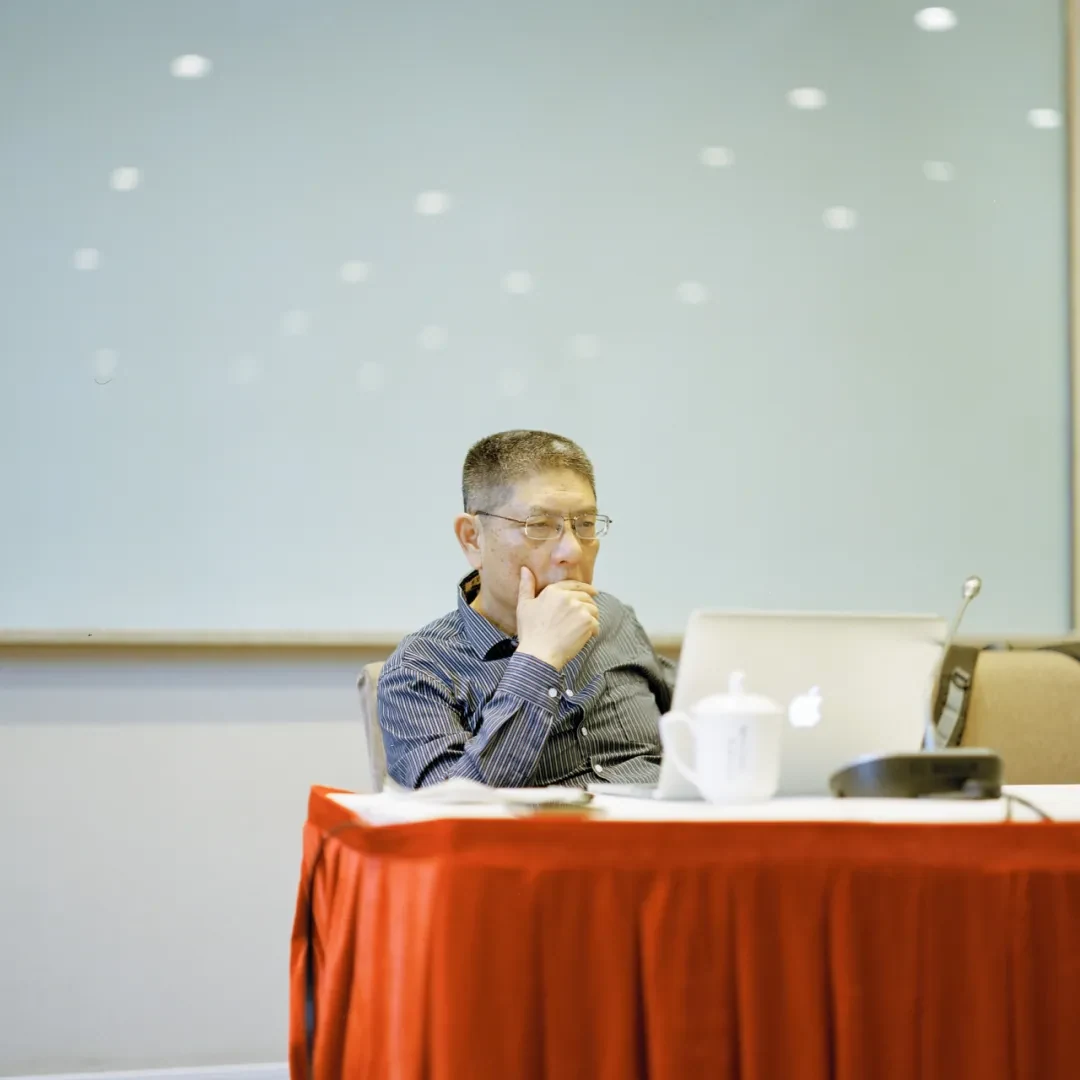
Handan Campus, Fudan University, April 22, 2021, photo by Guosen Chen
What I want to say is this: there is no such thing as an independent academic language. Whether a scholar is chatting in private or presenting at the podium, they are speaking Chinese, and the grammatical rules are the same; all that changes here is the way the language is used. All the parenthetical asides, the syntactic complications, the substitution of technical terms, the stretching out of sentence patterns, and so on, happen inside one and the same language. A term or an idea in the humanities can, in principle, always be unfolded again in everyday language. Heidegger's so-called "Dasein," for instance, can perfectly well be conveyed in plain speech; it just takes a lot of detail to make it clear—especially the reasons why Heidegger didn't use ready-made everyday words like "human being" or "subject." Those reasons have been condensed into the choice of the non-everyday word "Dasein." The concepts of the humanities and social sciences are all highly condensed concepts (commonly called "jargon"), and unpacking them means, for many people, a loss of precision. But the problem is that condensation does not automatically bring precision, and the reverse is also true. This "jargon" has always come in for a great deal of criticism, but jargon arises precisely because the complexity of experience makes it inevitable that we find a new concept, or a whole system, to give it a name. Concepts are what results from describing experience. Even something as vast as Kant's three Critiques came about because of the threat Newtonian mechanics posed to philosophy. Those concepts ought to have been the endpoint of experience, its naming, but later they became the starting point of experience instead, used to connect a given experience to a wider network of concepts.
All the academic language of the humanities and social sciences grew out of everyday language, and its semantic connections are likewise built on the basis of everyday experience. That is to say, the obscurity of the humanities and the flood of jargon in them have never been an unavoidable, necessary outcome—they are a choice, and always remain a choice. And if it is a choice, there must be reasons for it. The reason may be legitimate; for example, some experiences really do need technical terms to identify and name them precisely, so that we don't have to explain everything from scratch each time. But when obscurity becomes a whole style, it runs the risk of degenerating into a mere habit of expression.
Not only is there no independent academic language, but dependence on and use of academic jargon can also keep its users from really drawing on the academic resources they have acquired in order to look at the everyday world. This is what people call "studying yourself stupid." We have more and more tools for diagnosing life—instrumental reason, the society of the spectacle, modernity, consumer society, the big Other, the objet petit a—but our understanding of life itself, far from necessarily growing in step, actually risks shrinking. This seems a little hard to make sense of. It is precisely because the terms and the borrowed materials are so abundant that we find it very hard to notice this. Are the terms we have mastered the result of questions that crystallized out of genuine puzzlement about experience, or are they a rhetoric that carries its own air of authority? The former implies a kind of mastery that is almost genealogical; the latter is just an identity pass.
The great names in the history of thought we learn about in this process—whether Isaiah Berlin, Levinas, Schelling, or Hegel—all honestly faced the world they lived in, and they are remembered by later generations for the voice that this honesty produced. When someone has all of this knowledge at their fingertips, we habitually describe them as "deeply learned." Yet the "learning" we sense in an encyclopedia and the "learning" we sense in scholars like Chen Jiaying or Cheng Lesong are necessarily different. I think the reason lies in the relationship between knowledge and the person. This is also why so many people who have learned a great deal of philosophy not only still fail to see the structure of their lives clearly, but end up more muddled by all that knowledge. In such a case, the relationship between the knowledge and the person is one of possession, like the tools in a toolbox. They can keep accumulating more tools by studying. In the other case, the knowledge is not something the person possesses; it has entered their own lived experience and changed the way they see the world. Through long acquaintance with ideas, a person has undergone a certain change. The accumulation of knowledge is no doubt extremely important in this process, but once the change it brings about has happened, it no longer exists in the form of knowledge. It becomes the way a person perceives and responds to problems. And this way of perceiving and responding in turn reshapes a person's judgment and the way they ask questions.
So why is it that a refined mastery of knowledge in the humanities and social sciences carries the danger of preventing someone from using these resources to look at the lifeworld? Because this knowledge, especially knowledge in the form of jargon, changes the relationship between a person and their own experience. Once a student has acquired a system of terms through academic training, that system forms an intermediate layer between them and their world. The function of this intermediate layer is classification. Classification spares us the chaos of experiencing things, and so we would rather pare down the richness of experience than go without the temporary settledness it gives our reason. When this intermediate layer already precedes any experience, the system of terms gets in ahead of feeling, filing experience away before the feeling is even complete, and this filing happens so fast that it is extremely hard to notice. I am reminded of what Cheng Lesong said in an interview:
I'm just someone who can explain a problem clearly. Whatever problem you have, I can tell you about it, but as for how to solve it, I don't know either. When I run into the same problem, I fall into the same state you do. But I know why I've fallen into that state. That's the only difference.
This is a description that looks very easy, and it might even make people think, "What's so remarkable about that?" Yet the effort behind it cannot be underestimated. It requires a person to keep their capacity for analysis while living through and experiencing something, and under normal circumstances these two are mutually exclusive. The point could perfectly well be dressed up in jargon like "phenomenological suspension," but for me the end result of the whole training in the humanities, of all those books we read and all those questions we thought about, comes down to nothing more than what is condensed in the passage above: knowing why one's life has turned out this way. Only then can a proper starting point be formed, just as only an extreme flourishing of the Apollonian spirit can make possible the birth of the Dionysian. There is a popular saying: "I understood so many principles, and still couldn't live this life well." We might blame the "principles" themselves for this, but the "principles" here, even if they are firsthand principles, are not responsible for solving life's predicaments. Practical reason and theoretical reason belong to different domains. We don't become better by studying these things, but we do come to know more clearly why our lives have turned out this way.
Cheng Lesong has an extremely incisive formulation, the so-called "secondhand life." For people who do academic work, the "secondhand" here means, I think, the domination of experience by technical terms. We think that through the terms we have already understood something, when all we have done is find a box for it to go in. In this situation, what the terms provide is a prefabricated understanding, and we then take it for our own judgment. Every act of classification is at the same time a turning away from experience; once we have gone off to where the concepts are, it is very hard to come back again.
I am by no means denying the value of jargon and technical terms. When a term is created, it is always directly connected with its creator's feelings, and for that reason it names a whole tangled array of phenomena aptly and accurately. But once a term has been created and has entered the chain by which academic knowledge reproduces itself, it becomes uncoupled from that feeling (which is also why I think training in genealogy matters just as much). At that point, the term becomes a tool for labeling and classifying. This is why jargon keeps people from drawing on academic resources to analyze the everyday world. For me, when facing experiences, it is already enough simply to describe them honestly, until they become clear to the point where we can recognize the experience itself, and recognize the differences between this experience and that one. Naming is no more than a by-product of this process of questioning.
As I see it, the real content of the academic resources of the humanities and social sciences is not the terms, nor the complicated ways of constructing sentences, but the feelings and questions to which this knowledge was responding when it was created. In other words, it is the living puzzlement and feeling to which these "labels" were responding when they were created. Take Freud's "uncanny," for example. We all know that it names the unease brought about by the return of something familiar. But why is it that what unsettles us is precisely what is most familiar to us? If this question really enters our experience, it will change the face of our everyday world; whereas if "uncanny" is merely a term in a knowledge base, it will only be activated in academic settings, used to deal with argumentative resources that exist, when we write papers, as words rather than as experience.
This brings us back to what I wanted to say at the start: there is no independent academic language, and there is no independent everyday language either. We have only one language, and it is the language we use both to feel and to think.