A Cup of Coffee and How We Imagine Poverty
1.
I was scrolling and came across a news story: a student receiving need-based aid had been reported for buying 9.9-yuan cups of Luckin coffee. A classmate had spent 37 consecutive days collecting her meal records and order screenshots, and then reported her to the university's financial aid center, on the grounds that she did not seem like a poor student at all. The student herself felt wronged: the money came from her own work-study job, she had not touched a cent of her grant, she was too sleepy for her 8 a.m. classes every day and needed something to keep her awake, and she could not understand why everyone was so set against her doing this. The largest share of the comments were concerned with drawing lines around which kinds and levels of spending were legitimate, working out the ratio of coffee money to grant money in order to argue that her spending was illegitimate, and concluding that she "didn't deserve" to be counted as a poor student, or "didn't deserve the grant."
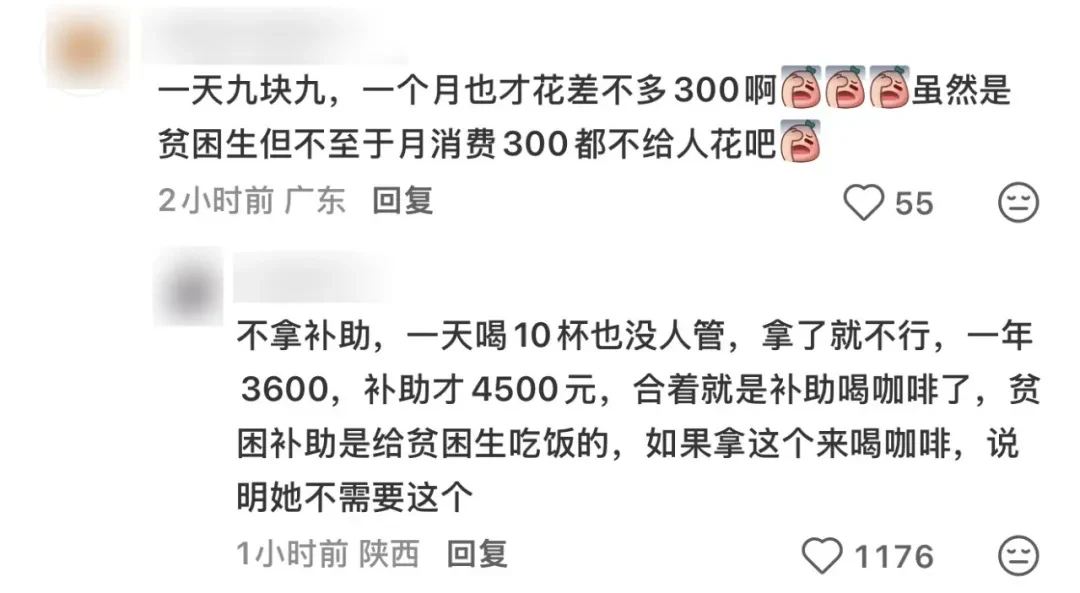
Comment: “¥9.90 a day only comes to about ¥300 a month 😫😫😫. She may be a student from a poor family, but surely that doesn't mean she isn't allowed to spend even ¥300 a month 😫.”
Reply: “If you don't receive financial aid, nobody cares even if you drink ten cups a day. If you do, you can't. That's ¥3,600 a year, and the aid is only ¥4,500. So the aid is basically paying for coffee. Financial aid for poor students is meant to pay for their meals. If she's using it for coffee, that shows she doesn't need it.”
My sense is that this whole affair keeps getting tangled up with two basic questions, and because the people on the various sides of the discussion seldom see these two interdependent dimensions clearly, the argument can never be settled, and nothing is actually done to improve the situation of people who receive aid in the way she does. The first is the question of "the system": people tend to come down hard on a particular person rather than ask whether the system makes sense. The system explicitly provides for ongoing review of a recipient's eligibility, but that review has a clearly designated body to carry it out and clearly designated channels for appeal. This means that institutional review and personal moral judgment are two different things, and one cannot exercise the latter in the name of the former; doing so in effect revokes the system's effectiveness as a threshold for entry and as a mechanism of review. The second question is perhaps the more important one, and it concerns how we imagine "poverty": how ought we to look at poor people? And how is the way we imagine poor people shaping our society?
Of course, if you just look at what happened, the strangest thing may be that one person can spend 37 days (or even longer) tailing, staking out, and recording another person's daily spending, and turning it into evidence for a report, and yet what everyone is discussing is whether the person who was tailed deserved that cup of coffee...
2.
One kind of comment basically reduces "poverty" to a calculable condition and then uses arithmetic to rule on whether a person's behavior matches that condition. For instance: 9.9 × 365 = 3,613, and the grant is only 4,500 a year. Put that way, it does look alarming.
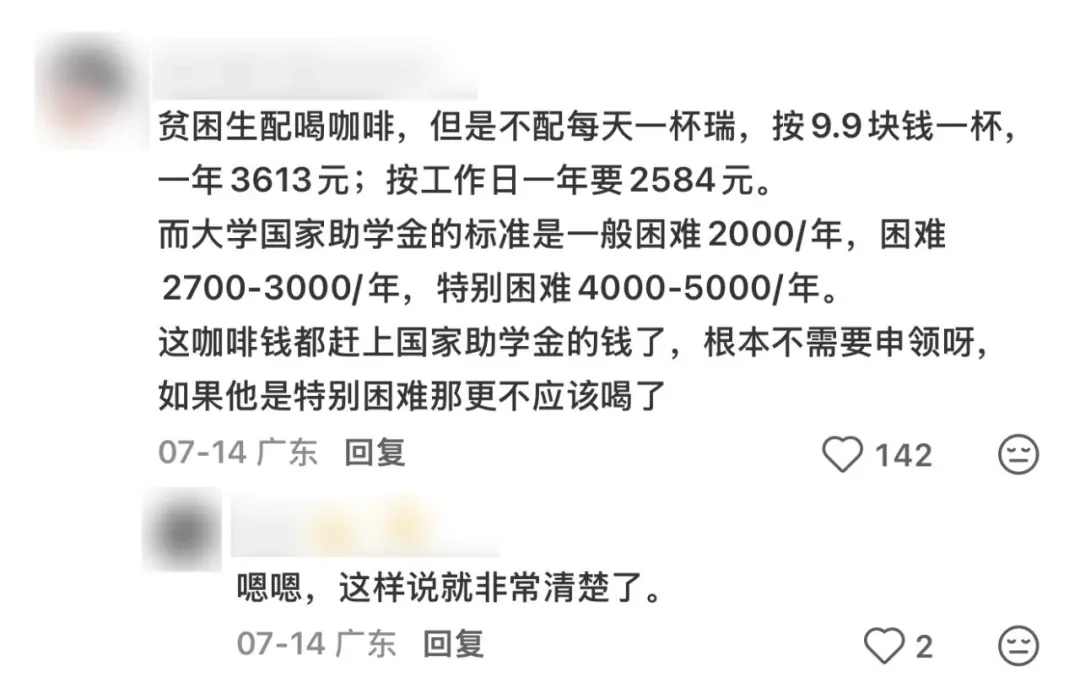
Comment: “Students from poor families deserve to drink coffee, but they don't deserve a Luckin coffee every day. At ¥9.90 a cup, that's ¥3,613 a year; counting only working days, it's ¥2,584 a year. The national university student grant is ¥2,000 a year for general financial hardship, ¥2,700–3,000 for hardship, and ¥4,000–5,000 for severe hardship. The cost of this coffee is already approaching the amount of the national student grant. There's simply no need to apply for it. If the student is in severe hardship, then they have even less reason to drink it.”
Reply: “Yes, yes, put that way, it's very clear.”
Still, arithmetic easily produces an illusion of objectivity, and its rhetorical effect is to reduce a judgment about another person's life to an equation that cannot be argued with. Once the discussion has been boxed in by an equation, nobody asks whether the act of calculating is itself reasonable: why should a formula like this be able to establish the conclusion that "this person doesn't qualify as a poor student"? Or, put another way, if this algorithm really were so effective, why would we have needed to develop such an elaborate system for reviewing grant applications? A judgment this neat is the one most likely to give people the intellectual pleasure of having seen through appearances. But, leaving aside the fact that the grant is not the student's only source of income, and leaving aside the fact that she has a work-study job, the crucial question is: what is a "grant" for? Isn't its purpose to help a student maintain a basic university life? That is a different thing from every cent having to hold up under a public audit. It seems as though someone who takes a grant has to learn to "perform" poverty. That is to say, it is not enough to be poor in terms of one's objective economic conditions; one must also, in every visible detail of daily life, continuously and consistently perform one's identity as poor. Any crack is liable to be criticized as a mismatch, and the mismatch is then read as a flaw of character, which opens the way to a wholesale critique of a particular person's way of life. Someone also said: "Is drinking ten-yuan coffee against the law? No. But it shows indirectly that this person isn't poor. Take a car worth a few hundred thousand: an ordinary family these days could afford one with a loan and some effort, but an ordinary family wouldn't consider it." And so a 9.9-yuan cup of coffee and a car worth several hundred thousand get put into the same argumentative structure, and the only thing connecting them is the abstract category of "spending that doesn't match one's identity." In other words, for someone who has been filed under "poor," the actual amount doesn't matter; what matters is whether every purchase strictly confirms that person's identity as "poor," and that identity is often itself an image of poverty we have inherited from some cultural convention.
3.
The most common kind of comment is probably the testimonial: people cite their own frugality (say, that after four years of working, or while earning ten thousand a month, they still can't bring themselves to buy a coffee every day) as evidence that the student's spending was inappropriate, and argue that she could perfectly well have bought cheaper instant coffee powder to stay awake. I fully affirm the value of this frugal way of life, and I have come to feel, more and more, how necessary such a life is.
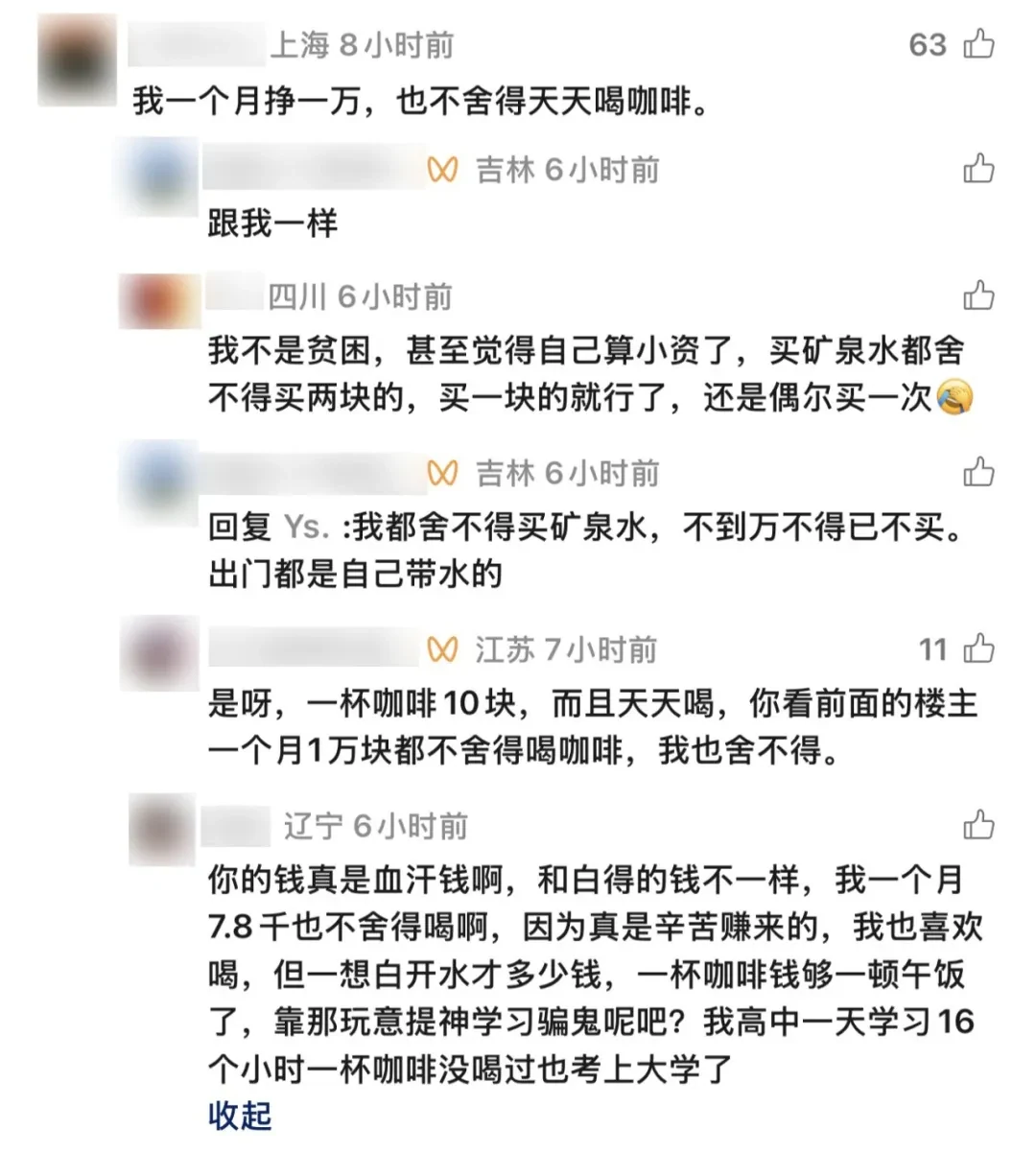
Comment: “I earn ¥10,000 a month, and even I can't bring myself to spend money on coffee every day.”
Reply: “Same here.”
Reply: “I'm not poor. I even think of myself as comfortably off, but I can't bring myself to buy ¥2 bottled water. The ¥1 kind is enough, and even then I only buy it occasionally 😂.”
Reply to Ys.: “I can't even bring myself to buy bottled water. I only buy it when I absolutely have to. I always bring my own water when I go out.”
Reply: “Exactly. A coffee costs ¥10, and she's drinking one every day. Look at the original commenter above: they earn ¥10,000 a month and still can't bring themselves to buy coffee. Neither can I.”
Reply: “Your money really is hard-earned money. It's different from money you get for free. I earn ¥7,000–8,000 a month, and I can't bring myself to buy it either, because I worked hard to earn that money. I like coffee too, but then I think about how little plain water costs. One coffee costs enough for lunch. Using that stuff to stay alert and study? Who are you kidding? I studied sixteen hours a day in high school, never drank a single coffee, and still got into university.”

Comment: “😭 Why are so many workers earning over ¥10,000 a month saying they can't afford ¥9.90 every day? Isn't that a bit exaggerated?”
Reply: “We can't bring ourselves to spend it 🥺. We have other expenses too. After all, this isn't a necessity, and there are even cheaper alternatives.”
But what opinions of this kind do, in this particular case, is give the speaker a position that is almost impossible to argue against. When people offer themselves as the example, they are in effect establishing their own moral credentials while automatically downgrading what the young woman did. We can't say this person's experience doesn't count, because it really is their lived experience. And at the same time it is hard to object that their standard has overstepped its bounds, because doing so is too easily read as an attack on frugal habits. This seemingly modest rhetoric seems closer to measuring other people's behavior by one's own endurance (which is a feeling), and in the process both logic and the effectiveness of the system quietly drop out of sight. More importantly, I think there is another reason so many people endorse criticism from this angle: most of most people's lives really are made up of countless small acts of restraint, and that restraint of course includes things like "should I spend 9.9 on a coffee," and also things like racking your brains to stack coupons when ordering takeout. And these countless small acts of restraint and endurance hardly ever get acknowledged as a whole. Think of a social metaphor that has been popular recently: you can't keep giving someone laxative enemas when the reason they can't poop is that they have nothing to eat. And whoever that metaphor is protesting against would never in a million years admit the fact it points to. None of these moments can be reduced to the single matter of "saving money"; what they amount to is a constantly repressed desire and the self-persuasion that follows it, namely: "I don't need this" / "my situation doesn't entitle me to have this" / "I held back and didn't buy it, and I was right"... This self-restraint born of repression seems to make up a hidden source of self-respect: because I held back, by my own standards I am someone who lives the right way. And when someone labeled a "poor student" fails to exercise similar restraint, the situation may well trigger their anger: if this student doesn't have to hold back, then what was my holding back worth? Comments of the "my circumstances are better than hers and even I can't bring myself to spend like that" sort are in fact, every word of them, about the speaker.
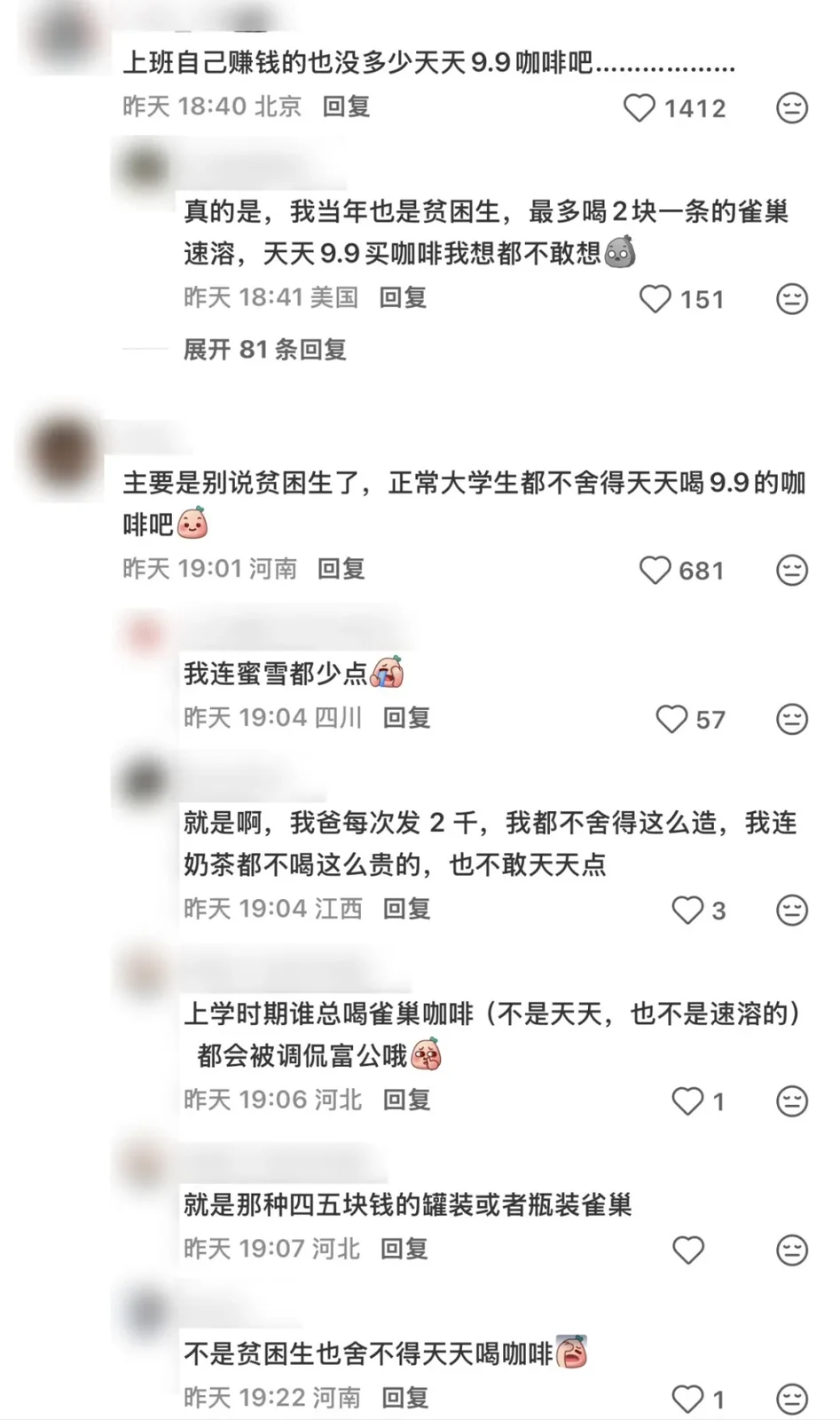
Comment: “Even among people who work and earn their own money, there can't be many who buy ¥9.90 coffee every day, right…”
Reply: “Exactly. I was a student from a poor family back then too. The most I would have was Nescafé instant coffee at ¥2 a sachet. I wouldn't even have dared to imagine buying ¥9.90 coffee every day 🥺.”
Comment: “The thing is, never mind students from poor families: even ordinary university students can't bring themselves to buy ¥9.90 coffee every day, can they? 🥺”
Reply: “I rarely even order Mixue 😭.”
Reply: “Exactly. My dad gives me ¥2,000 each time, and I still can't bring myself to spend like that. I don't even drink bubble tea that expensive, and I wouldn't dare order it every day.”
Reply: “When we were at school, anyone who often drank Nescafé, even if it wasn't every day and wasn't instant coffee, would get teased for being rich 🥺.”
Reply: “I mean the canned or bottled Nescafé that costs ¥4 or ¥5.”
Reply: “Even people who aren't students from poor families can't bring themselves to buy coffee every day 😫.”
What this kind of self-testimony does in the present context is use one's own personal experience to rule on the legitimacy of another person's spending: it goes from "I choose to save" to "everyone whose situation resembles mine must do the same, or else they are being dishonest." There is a strange moral intuition at work here, namely that poor people must not only actually be frugal, but must always choose the most frugal option, and that any deviation from it is morally suspect. I wonder whether the people who say the student could perfectly well have bought cheaper coffee powder realize that this logic applies just as well to themselves: since you consider yourself frugal, you could eat the cheapest dish in the cafeteria, but you could also eat nothing but steamed buns and pickled vegetables; you could buy cheap clothes, but you really ought to buy even cheaper second-hand ones. If the standard of evaluation is "can a person live on less money," then the standard has no floor; where it ends up is demanding that the poor strip from their lives everything that cannot be classified as necessary for survival. And what counts as necessary for a person's survival? What, accordingly, qualifies someone as "poor"? I doubt any objective standard can be found; after all, Bear Grylls can spend not a single cent and still "live just fine" in the jungle. Of course, comments of this kind are not really demanding that a poor student push their standard of living down without limit (though in fact they have that effect, as I will explain later). What they really care about are two things: first, the question of the student's spending not fitting her identity as a "poor student"; second, the question that the grant comes from public funds, and public funds must carry a corresponding accountability.
On the first point, as I said earlier, the very act of "fitting" presupposes a particular image of the "poor student," and that image is filled in entirely by onlookers out of their own imaginations and experience. Some people think a poor student is fine as long as their phone isn't an iPhone; some think it's fine as long as they don't buy Starbucks. Different people have different thresholds for "what a poor student looks like," and these thresholds share no common standard. When these judgments, each with its own threshold, converge on one person, the concrete effect for that person is this: they find themselves pushed back into a position where they are required to cut out all so-called "unnecessary spending" and to push their standard of living down without limit. Although no single opinion requires them to approach the minimum without limit, all the opinions taken together form a force pressing down toward a floor that does not naturally exist.
There is one more thing to add here: what is happening is that a visible act of consumption is being used to infer a judgment about a person's economic situation. All of us, in everyday life, frequently work backward from our estimates of other people's housing, cars, clothes, and other things they've bought to their economic situation, and there is nothing wrong with that in itself. But the inference is far less reliable when it runs "from Luckin coffee to poor student." A 9.9-yuan Luckin coffee carries nothing like the signaling value of a luxury item. Someone earning 3,000 a month and someone earning 100,000 a month can both buy one, and the former may drink one every day while the latter thinks a 9.9-yuan coffee is "too expensive" or "not worth it." Yet within the framework of identity-fitting, it is given a weight far beyond the information it actually contains.
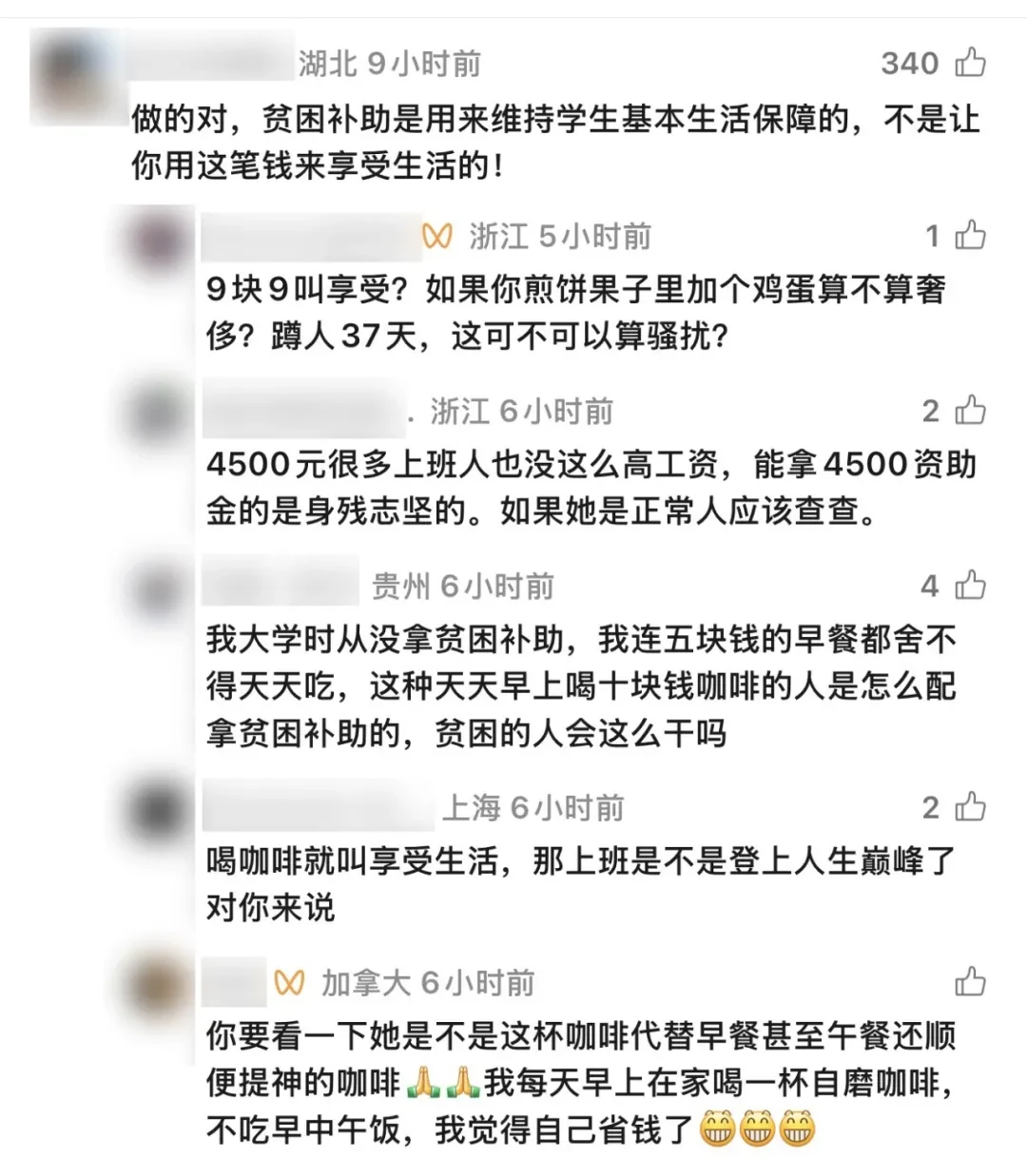
Comment: “They did the right thing. Financial aid for poor students is meant to cover students' basic living needs. It isn't for you to use that money to enjoy life!”
Reply: “¥9.90 counts as enjoying life? If you add an egg to your jianbing, is that a luxury? Following someone around for thirty-seven days: could that count as harassment?”
Reply: “¥4,500: plenty of working people don't even earn that much. The people who can receive ¥4,500 in financial aid are those with disabilities who persevere despite them. If she's able-bodied, they should investigate.”
Reply: “I never received financial aid for poor students at university, and I couldn't even bring myself to spend ¥5 on breakfast every day. How does someone who drinks ¥10 coffee every morning deserve financial aid for poor students? Would a poor person do that?”
Reply: “If drinking coffee counts as enjoying life, does going to work count as reaching the pinnacle of life, as far as you're concerned?”
Reply: “You need to see whether that coffee is replacing her breakfast or even her lunch, while also keeping her alert 🙏🙏. Every morning I drink a cup of coffee I grind myself at home, and skip breakfast and lunch. I feel like I'm saving money 😁😁😁.”
Now for the accountability of funds. Using public funds does come with accountability attached: the grant comes from government appropriations, and the appropriations come from taxes, so some form of oversight over where this money goes is, in principle, legitimate. Any allocation of public resources needs a mechanism for checking it; otherwise the basis of trust in the system disappears. But to what degree should the people using the funds be held accountable? "If you take public money you have to accept oversight" is true at the abstract level, but its range of validity, or what it guarantees, is that the body responsible for eligibility review verifies and re-verifies eligibility according to its institutional procedures. And as we saw, that is exactly what the university did after receiving the report. What happened in the arena of public opinion, however, is that any individual at all felt entitled, in the name of this principle, to appoint themselves judge of someone else's way of life. And before that, of course, the precondition was that one person carried out sustained surveillance of another person's daily life and submitted coffee orders and screenshots as evidence that she "didn't deserve aid." We need to see that the legitimate way of holding public funds accountable is to verify, or re-verify, whether this person's economic situation meets the system's conditions for aid, not to check whether every single purchase they make sufficiently fits the image of "poverty." The former is a factual question with a clear procedure and solution within the institutional framework; the latter is a normative demand about "how poor people ought to live." That demand is not itself part of the grant system.
Of course, if someone says, "I'm only talking about how unreasonable it is to buy a coffee every day; I'm not trying to review every purchase," then the question is: on what principle did we single out "coffee" as the purchase in question? In the end it still points to the standard of "non-essential spending of a certain frequency and cumulative amount," and that standard does not automatically guarantee that it applies only to coffee. So if we really accept that this is reasonable, we are back to the problem I raised earlier: under the combined force of all these demands with their differing standards (as the old saying goes, when punishments cannot be known, their terror cannot be measured), a student on a grant will find that not only can they not buy a 9.9-yuan coffee, they may not be able to spend 30 yuan on a movie either, because if you keep calculating along these lines, any everyday expense can be made, mathematically, to look "astonishing over a whole year." And people who offer this sort of defense usually go on to draw a line, saying: one a day is too much, but one now and then is of course fine. But where that line is drawn is entirely arbitrary, and what matters is this: the person under scrutiny will never know whether their next purchase will cross the line in some onlooker's head. This means that this kind of scrutiny is fundamentally opaque, depending entirely on the scrutinizer's own economic situation and on their image of "the poor." It acknowledges the integrity and legitimacy only of its own economic situation, and trusts the value judgments that arise from it, while denying the integrity of the economic situation of the person it scrutinizes.
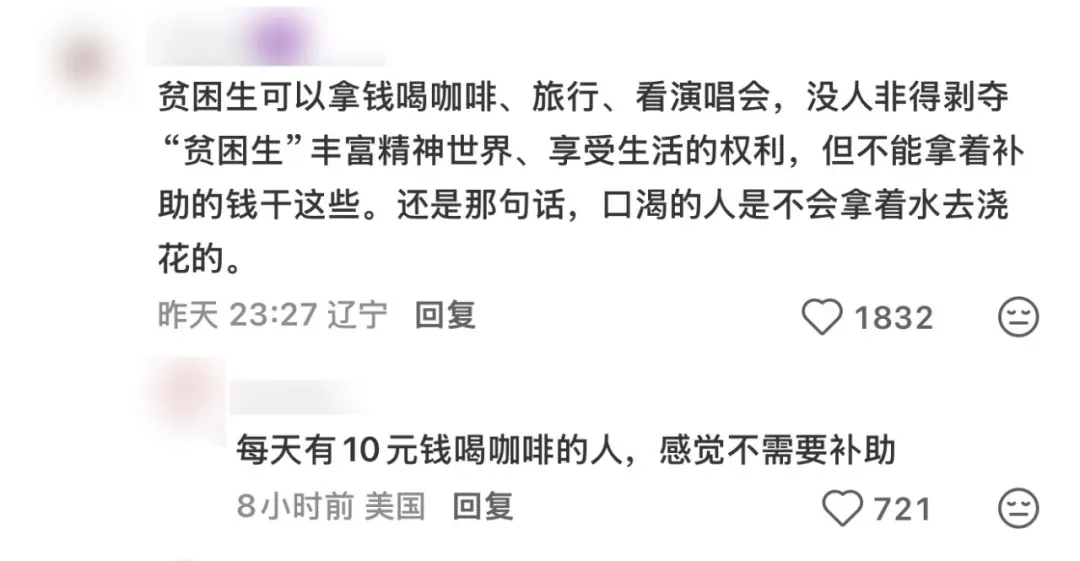
Comment: “Students from poor families can spend money on coffee, travel, and concerts. Nobody insists on depriving ‘poor students’ of the right to enrich their inner lives and enjoy life. But they can't use financial aid money for those things. I'll say it again: someone who's thirsty won't use their water to water the flowers.”
Reply: “Someone who has ¥10 every day to spend on coffee doesn't seem to need financial aid.”
4.
There is another, more fundamental matter that few people seem to have noticed, namely: what exactly is a grant for? The view that taking the money means submitting to the public's moral scrutiny tends to imagine the grant as a kind of favor or privilege, and holds that since recipients have received this extra benefit, they are obliged to live in a manner befitting it. But Caijiao [2021] No. 310, the *Measures for the Administration of Student Financial Aid Funds*, states explicitly that the function of the grant is "to assist students with family financial difficulties among full-time undergraduate and junior college students enrolled at higher education institutions within the national enrollment plan"; similarly, the *Interim Measures for Social Assistance* characterizes the minimum living allowance as "living support provided to families in which the per capita income of family members living together is below the local minimum living standard." That is to say, it is simply a means of assistance. In other words, the grant is not, by design, a favor; it is just a form of support based on the objective fact of economic hardship. It addresses an objective economic fact, not the recipient's character, and its aim is to let students from families in poor economic circumstances complete their studies normally, just like other students. And shouldn't "completing one's studies normally" also include the basic room for choice that a university student has in daily life? If a recipient's life has to be pruned by collective opinion until it excludes whatever unpredictable onlookers consider "unnecessary," then what becomes of "helping a person live a normal life"? We need to see that the regulations governing grant funds set no whitelist of permitted uses, of the sort attached to earmarked subsidies, for the stage after the money has been disbursed. In terms of institutional logic, this means that within the rather broad category of "living expenses," the recipient has real discretion over how the money is used. Of course, this does not mean that such discretion is subject to no constraint at all — the system's mechanism of ongoing review itself presupposes that the reasonableness of spending can be taken into account in a review — but the body that enforces the constraint, and the procedure it follows, should be the system itself, not social onlookers who have no standing whatsoever to judge. So while the system specifies that the grant is to be directed toward living expenses, within that category it does not specify that recipients may only choose the lowest-cost option. And when we demand, on moral grounds, that every purchase a recipient makes must pass onlookers' review of its reasonableness, we are in fact informally legislating a spending plan that the system itself never provided.
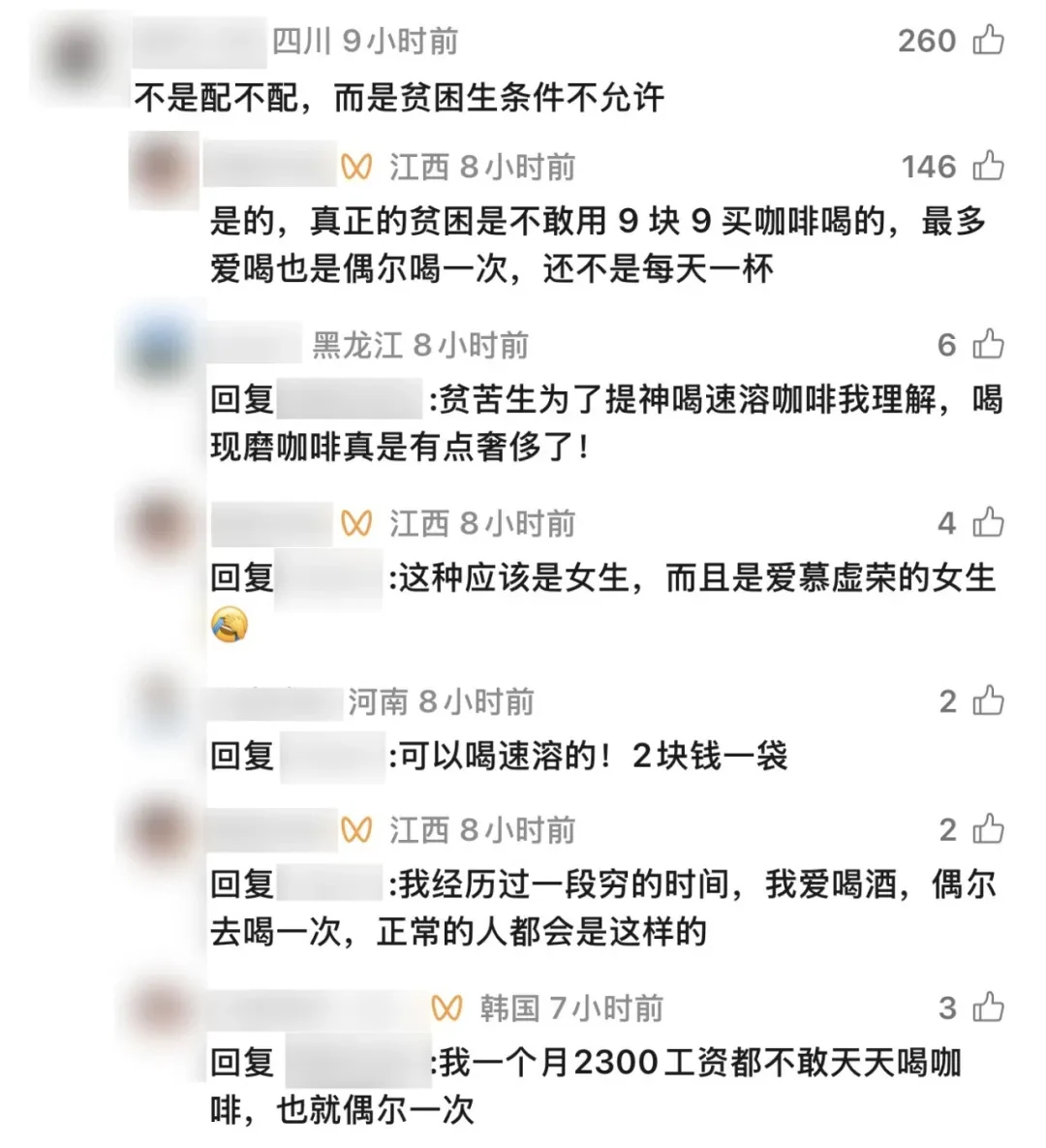
Comment: “It's a question of whether a poor student's circumstances allow it, rather than whether they deserve it.”
Reply: “Yes. Someone who's genuinely poor wouldn't dare spend ¥9.90 on coffee. Even if they love it, they'd have one occasionally at most, rather than one every day.”
Reply: “I understand a poor student drinking instant coffee to stay alert. Drinking freshly ground coffee really is a bit of a luxury!”
Reply: “This must be a girl, and a vain one at that 😂.”
Reply: “They can drink instant coffee! ¥2 a sachet.”
Reply: “I've been through a period of poverty. I like drinking, but I'd only go for a drink occasionally. That's what normal people would do.”
Reply: “I earn ¥2,300 a month and wouldn't dare drink coffee every day either. Just occasionally.”
5.
Imagine a somewhat inhumane scenario: an unemployed man gets only 800 yuan a month in minimum living allowance, but he has to spend 300 yuan of it a month on alcohol, 10 yuan every day for a bottle of beer. Would we think this expense must be cut, or else he shouldn't receive the allowance? I suspect not; we might even feel that he "has no choice, or he couldn't go on living" (why?). Of course, in the actual administration of the minimum living allowance, monitoring of recipients' spending is just as widespread, and that is itself an expression of the same mechanism. Even so, one difference remains very clear: in both cases money is being spent on "non-necessities," but the image of drinking beer and the image of drinking coffee trigger different reactions in us. This may also be because we are more or less aware that if every expense were reviewed for its reasonableness, the system would collapse. So why is it that when the subject is swapped for "a young female university student who drinks a Luckin coffee every day," she has to bear this kind of accusation? We seem rarely to subject the beneficiaries of other public resources to scrutiny of comparable intensity. Would we demand that a business owner who benefited from a tax cut disclose how much he spends on each meal? Would we say that a person living in government-subsidized housing is eating out in a way that doesn't match their status? I suspect few people even realize that they "should" do this. What this shows is that the intensity of scrutiny is almost always inversely proportional to the scrutinized person's position in the social structure: the closer to the bottom you are, the more you are required to be transparent and to prove your innocence. In this process, the principle that "if you take public money you must accept scrutiny" has already been aimed, in a highly distorted form, at particular groups, and what it is aimed by is not any actual need for accountability, but a social intuition about who ought to be grateful upward from below, and whose life ought to be subject to other people's gaze and scrutiny.

If we take the man on the minimum living allowance I just described as a thought experiment and carry it further, we might imagine it this way: there are now two people. The first receives the allowance and lives normally; in appearance and behavior he may be no different from us. The second receives the allowance but (has no choice but to) drown his sorrows in drink every day (I'm thinking of the old soldier in Shi Pin Dao's *Hello, America*). Which of them would you feel more sympathy for? I suspect that quite a few people's first instinct would lean toward the second, with a kind of understanding mixed even with pity. And I'd guess not many people would reproach the second man for wasting taxpayers' money too, and demand that he stop receiving the allowance. What I want to say is this: if in this thought experiment we lean toward sympathizing with the second man, then we actually have to affirm the young woman's legitimate right to buy coffee. Alcohol is harder to classify as a "necessity" than coffee is, and this proves that what our judgment on this question actually rests on is not the proper use of public funds, but something else — an image of "what a poor person's life should look like." What I have been trying to argue all along is that this image does not take a reasonable form. By rights, drinking on the minimum living allowance should attract more criticism than Luckin coffee, and yet we readily feel that this man must be having such a hard time that he can't get by without a drink. The heart of the matter is that, in our perception, the two acts of drinking coffee and buying alcohol stand in almost opposite relations to the identity of "poor." The picture of an unemployed man drinking does not conflict with the image of poverty in our cultural imagination; on the contrary, it reinforces it, because it signals that this person is, at this moment, stuck, dispirited, and unable to pull himself out. Spending on alcohol points to suffering rather than agency. A young female university student drinking a Luckin coffee every day calls up the opposite cultural image (some people even attribute it to young women's "vanity"). The symbolic meaning that Luckin coffee carries in today's consumer culture, however cheap it actually is, leans toward an everyday urban consumer lifestyle, and that lifestyle is inherently incompatible with our image of "poverty." And so a conclusion that may make us quite uncomfortable presents itself: how much tolerance we have for "poor people's" spending does not really depend on the amount spent, but depends to a large extent on whether the purchase still preserves the way we think a poor person ought to look. That is to say, the variable that really determines how strongly we react is the degree to which the purchase interferes with the recognizability of poverty.
This brings us to the question of how society as a whole manages the visibility of poverty. (In most situations) our tolerance of the poor comes with an implicit condition: poor people may spend money, provided they spend it in a way that still lets them look poor. And this raises an even more damning problem: a person drinks coffee in order to stay alert and throw themselves more fully into study and work. A person who drinks alcohol, in the great majority of cases, is not serving the goal of "making myself more productive." Whether we are talking about poverty relief or student aid, if we admit that, in utilitarian terms (setting aside goals like "helping a person live a normal life," which lean toward a sense of worth and self-realization), the point is to raise the productivity of the people being helped and thereby raise the productivity of society as a whole, then we have to answer this: why are we inclined instead to tolerate spending that lowers productivity and to condemn spending that raises it? Obviously there is a direct contradiction between the two. A poor student spending 9.9 to keep herself awake in an 8 a.m. class is, to a considerable degree, acting in line with what the system was set up for: it directly serves her studies, her studies lead directly to her future value as labor, and that is precisely what the grant system ultimately produces in utilitarian terms (if the claim is that she should have bought something cheaper to stay awake, I have already dealt with that: it is in fact a demand that can be extended without limit, because its standard is arbitrary). Conversely, if an unemployed man spends a third of his minimum living allowance on alcohol, and the alcohol improves none of his abilities and may even physically weaken his capacity to look for and hold a job, then, if the system's logic really were a logic of productivity, that would be the spending most deserving of challenge. Besides showing, once again, that the variable actually driving our reactions does not lie along the dimensions of utility and fairness, this may also show that the difference in how we perceive drinking coffee and drinking alcohol has to do with the state of the subject that each implies. Someone who can buy a coffee every day to keep herself alert so as to apply herself better to her studies displays a kind of initiative: she is someone who has goals, who can manage her own condition, and who treats her own life the way a rational agent would. Whereas someone who has to rely on alcohol every day just to get through it looks as though he has lost all room for choice. It is precisely this difference in the subject's condition that determines our emotional reactions. In other words, we subconsciously cannot accept that someone placed in the category of "needing help" should behave too much like someone who needs no help — that is, when this person actively and strategically runs her own life, allocates every cent as a resource, and uses her own reason to make a judgment (spending this 9.9 here is worth it for me, and I have my work-study job to cover it) and then acts on it, all of this is what an agent with considerable agency can do. And there is an obvious tension between that image and a "poor student who needs to be helped." Our expectations of aid recipients sometimes conceal a restriction on their subjectivity: if this person can manage her own life so neatly, then what is my help worth? At that point a "who does she think she is?" wells up from somewhere deep inside. What this relationship may be protecting is a moral narrative: we are indeed helping those who need help, and the precondition for this is that the person being helped must remain in a state of "needing help" at all times, so that we can establish that the relationship is taking place. So this may also suggest that our expectations of aid recipients are, to some degree, opposed to the recipients' actual interests — the system's goal is to make the recipients' lives better through assistance, but in certain specific situations (note: "in certain specific situations"), society's expectation is that the way these people get better must not make them look as well off as the rest of us. And so for some people (often those who have not accumulated much in the way of social resources), this is an extremely twisted double bind: you must improve your situation to prove that our money wasn't wasted, and at the same time you must keep up the outward appearance that your situation has not improved. For the person placed under these demands, the only safe image is that of someone who always looks helpless, someone who allows the helpers to confirm the value of their own help.
6.
Morally speaking, nobody could possibly think "we want poor people to remain visible at all times," because everyone sincerely believes that we should abolish class differences and bring about a world of universal harmony. But keeping poverty visible never shows up explicitly in our consciousness in the form of "I want us always to be able to tell, at the sensory level of daily life, who is poor." It usually appears under perfectly legitimate names like "fairness," "the reasonable use of public resources," and "being accountable to taxpayers," and each individual critic, in making a comment of this kind, really does subjectively experience a simple sense of justice. Someone who offers their own spending habits as an example, for instance, cannot possibly feel that they are squeezing another person's room to live; they simply feel that they are offering a reasonable point of reference. Precisely because of this, the thing never appears in its true form in any single individual. No individual consciously holds the position of "keeping the poor visible," so it cannot be pointed out at the level of the individual either. In fact, though, what countless well-meaning individual judgments, each internally consistent, spontaneously add up to is a mechanism that systematically requires the poor to keep their poverty visible, a mechanism with no designer, and no identifiable subject who can be held responsible. Everyone will say, "I was just saying what's fair," and the damning thing is that they really were just saying what's fair. So the fact that everyone sincerely believes that, when they speak, they are working toward abolishing class differences, far from solving the problem, is actually part of the problem: precisely because of this consensus at the level of ideals, people lose the motivation to examine their own concrete behavior — since I am, in my values, unquestionably on the side of fairness, how could my questioning of a poor student's spending possibly be against fairness? This self-confirmation makes the break between ideals and behavior even harder to recognize. A person may very well endorse both "I believe poor people should live the same lives we do" and "I think it's inappropriate for a student on a grant to drink Luckin every day," and although the two are in fact contradictory, they are usually not experienced as a contradiction, because the second statement tends to come with a series of mediations (such as "this is about paying attention to the transparency and fairness of resource allocation," and so on), which transform the form of the contradiction and turn it into a judgment that seems to have nothing to do with the first.
7.
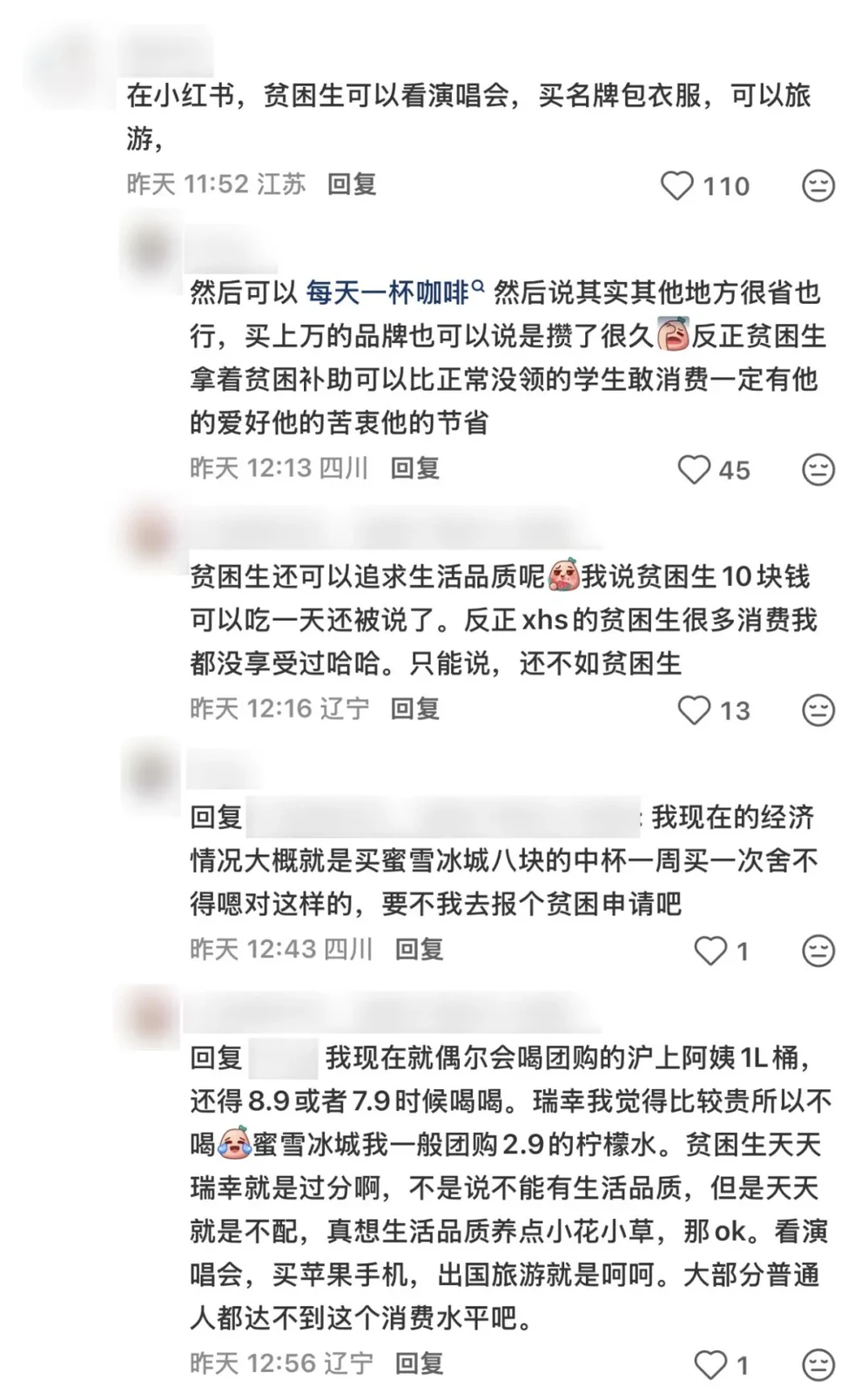
Comment: “On Xiaohongshu, students from poor families can go to concerts, buy designer bags and clothes, and travel.”
Reply: “And they can have a coffee every day, then say they save a lot in other areas. They can buy a designer item costing over ¥10,000 and say they saved up for a long time 😫. Anyway, with their financial aid, poor students can spend more freely than ordinary students who don't receive it. There must always be their hobbies, their hardships, and their thrift to explain it.”
Reply: “Poor students can even pursue a good quality of life 🥺. I said a poor student could eat for a whole day on ¥10 and still got criticized. Anyway, there are plenty of things the poor students on Xiaohongshu buy that I've never enjoyed, haha. All I can say is, I'm worse off than a poor student.”
Reply: “My financial situation right now is roughly that I can't even bring myself to buy an ¥8 medium drink at Mixue once a week. Yes, that's where I'm at. Maybe I should go apply for financial hardship status.”
Reply: “These days I only occasionally get a one-liter tub from Auntea Jenny through a group-buy deal, and only when it's ¥8.90 or ¥7.90. I think Luckin is pretty expensive, so I don't drink it 😭. At Mixue I usually get the ¥2.90 group-buy lemon water. A poor student having Luckin every day is excessive. I'm not saying they can't have a good quality of life, but every day? They don't deserve that. If you really want a good quality of life, grow some flowers or plants. That's OK. Going to concerts, buying an iPhone, traveling abroad: ha, ha. Most ordinary people can't reach that level of spending, can they?”
Among all the accusations made against poor students, there is one extremely common and widely endorsed type of scenario, and looking closely at it may well bring all of us to a point our own moral intuitions cannot bear: imagine someone receiving need-based aid who, by their own means, manages to get front-row tickets to a concert (which really is an expensive purchase for most people, and front row always implies "having connections" or "spending more money"), or who buys an iPhone (many "ordinary people" wouldn't buy an iPhone either). Should they have the right to do this? A great many people are explicitly against it. But why?
If we grant that someone who has never received any aid has the right to do this, then this student, by "successfully passing the review for scholarship and grant eligibility," ought also to have demonstrated that they are entitled to do it. One only needs to check whether the basis of one's view comes from a normative image of "the way of life a poor person ought to have" to settle this question. If we think that receiving aid means you must live in some "poor student" manner, I have already spent several thousand words clarifying why that view is unreasonable. Any accusation that fixates on whether some expense is too large and therefore unbefitting of someone's identity as a "poor student" falls within range of the argument this essay has made so far. A person passing the grant eligibility review means that their economic situation meets the standard for aid in the sense the system recognizes (at least to the point that the money can be put in their hands), and once the grant has been put in their hands, they have control over that money. In daily life this control is not substantively different from control over income obtained through other legitimate channels, and it is hard to separate the two in one's accounts anyway, unless the regulations explicitly stipulate that the funds are "earmarked" for specific items (as with medical insurance funds). Caijiao [2021] No. 310 explicitly describes the use of the grant as "to assist students with family financial difficulties in meeting their living expenses," and the system comes with no spending whitelist or itemized spending list. Some universities do explicitly add requirements like "living frugally" in their own institutional rules, but the vagueness of such requirements is precisely part of the problem: does a 9.9-yuan coffee mean one is "not frugal"? When a system uses an indeterminate concept like this without supplying corresponding standards for exercising discretion, it in effect hands that discretion over to the imagination of each and every onlooker. So if we accept that the system is effective — and if we don't, then we should be questioning and improving the system itself — then to use personal judgment, after the review has been passed, to deny the person's way of disposing of this money is in substance to hollow out the system, and this does not stop being true just because the amount spent goes from 9.9 to several thousand.
Now, some people also argue that since the purpose of the grant is to bring these students back up to an ordinary person's standard of living, and an iPhone clearly goes beyond an ordinary person's standard of living, they shouldn't buy one either. This argument is intuitively very appealing and easily wins agreement, but going along with it means accepting that the grant's function is compensatory equalization of consumption. That is, its purpose is to make a poor student's spending pattern as close as possible to that of a so-called "ordinary student," and as soon as some expense exceeds that ceiling, it counts as misuse of funds. But this brings us back to what I said earlier: the grant gives a sum of money, not a spending plan. Its core purpose is simply to enable students in financial difficulty to complete their studies; how that money is allocated in daily life (whether it goes on meals, or whether one economizes drastically in some areas in order to save up for something that matters a great deal to oneself) belongs entirely to the recipient's own planning of their life. A poor student might well eat the cheapest meals for two straight months, skip every social activity, and save up the money to go to a concert they've been waiting for a long time, and in total they may have been more frugal than another student who spends evenly every day. But in onlookers' perception, the former will always make us more uncomfortable, because at a certain moment their spending became highly visible, and it entered our field of vision in a way that carries a symbolic jolt. Of course, I am not saying that recipients' spending can never be questioned under any circumstances. If a recipient frequently makes large purchases, that is a reason for the system's review to be triggered. But does a poor student saving for two months to go to a concert mean their economic situation is no longer difficult? Not necessarily. Does it mean their pattern of spending doesn't fit some people's image of the poor? Almost certainly. And what a review by the system should care about is the former, not the latter.
Moreover, we also need to recognize that different people make the same purchase for different reasons. One person might buy an iPhone because they are learning iOS development and need a real device for testing, and it might be second-hand; or because they think the features of Apple's system genuinely suit their life very well; others may buy one simply to follow the crowd or out of vanity. We cannot assume by default that every poor student who buys an iPhone does so for the latter reason, and we absolutely cannot advocate reviewing people's motives for buying things, or else far more serious consequences will inevitably follow. That is to say, the meaning of a purchase cannot be read off the purchase in isolation: it depends heavily on the buyer's particular situation and motives, and these are inaccessible to onlookers. Each of these motives fundamentally changes the nature of the purchase, but for onlookers all these possibilities are compressed into a single uncomfortable symbol: "a poor student using an iPhone." What an uncomfortable juxtaposition that is! And this symbol thereby comes with a whole set of verdicts attached. Reviewing motives for spending is unacceptable not only because we cannot know another person's real motives (which is also why discussing "what the motive was" of the person who made the report is pointless), but because it means accepting a principle — once we accept the premise that aid recipients' motives for buying things can and should be subject to review, we have in effect agreed that certain parts of the inner life of people who receive public assistance have become a domain into which public opinion may legitimately intervene. A person now not only has to show others what they bought, but also has to explain to others why they bought it, and the explanation only counts if it passes other people's review of its reasonableness. So recipients lose not only their freedom to spend but also the privacy of their intentions. Once this kind of review of inner states has been legitimized or widely endorsed, there is no inherent limit to its scope: today you have to explain why you bought an iPhone; tomorrow you may have to explain why you chose this major rather than one with better job prospects; the day after, you may have to explain why you spent time at university dating rather than spending all your time studying. Because every such question can be justified by the same logic: you took public resources, so you ought to choose the way of being accountable for the optimal use of those resources, you ought to choose the fairest way. At that point, this person has in fact become someone whose life is managed on their behalf.
8.
To sum up, let me return to the two questions I raised at the beginning: the first concerns the effectiveness of "the system," the second the boundaries of "poverty." The reason almost nobody notices the first is probably that people don't, psychologically, really regard the conclusions of institutional review as something trustworthy. We vaguely feel that the review process and its standards are not fine-grained enough and not worth trusting, and so we redirect the questions that should be aimed at the design and implementation of the system into monitoring the spending of individuals. But the problem with this substitute form of accountability is that it cannot repair the system's defects, and at the same time, through the anonymous combined force of the crowd, it shrinks the living space of the monitored individual without limit. And, strangest of all, the more effectively it works, the more it suggests that the system itself is unnecessary. That is to say, if you were the aid recipient, you now have to pass the system's review, and the ongoing reviews that follow, in order to obtain and keep your aid, and you also have to pass a second review — outside the system, without standards, diffused through everyday glances — in order to keep your aid "with peace of mind." This second layer of review has no procedural justice to speak of; it can happen at any time, it can be initiated by anyone, and your only way of coping is to make your entire daily life look as if it would never trigger any onlooker's discomfort. Since the system has already arranged its own channels for review, informal review is in effect bypassing the system and, at the same time, bypassing the opportunity to improve it. And the reason this second review runs so smoothly is precisely that we have a collective image of "what poor people ought to be like." We still feel that "the poor" must be explicitly recognizable. For instance: poor people should be restrained; they should show hesitation and guilt about any spending beyond the bare minimum. Poor people should be grateful; they should be aware that they have received something that does not belong to them, and repay it with a visible humility. So what is this image of the poor for? Whom does it serve?
If poor people looked no different from the rest of us, and we couldn't tell who was poor by any visible means (appearance and behavior), would things be worse or better? Put another way, if we regard the poor as people who need help, should good help aim to let them live as much like us as possible (just as some accessible design is meant to do), or to keep their "poverty" visible at all times, so that we always know properly "how to help them"? I think almost all of us, without exception, would choose the former, but what actually happens, in this case and in many others, is the latter. This image of the poor, on the one hand, fixes the relationship between helper and helped, and a great many things can be confirmed by means of this fixing — for instance, the effectiveness of society's system for allocating resources, or the effectiveness of people's sympathy, and so on. Because the normal functioning of people's moral lives really does depend on a condition like this: we need to see who is being helped in order to confirm that help is happening, and to confirm that we ourselves are people who care about such things. Once this visibility disappears, many things that take it as a premise will be shaken, and this shaking may well also mean a loosening of a certain understanding of the social order. On the other hand, it in fact demands that poverty become an identity borne in every respect, rather than merely an economic condition. Once a person has been classified as "poor," they are expected to be poor in every respect, so as to keep that poverty visible to all onlookers.
The harm this does is that it systematically raises the psychological cost for poor people of seeking help. If a person knows that accepting aid means their life will be placed under informal public surveillance (just as happened to this student: you may, without realizing it, be subjected to a month or more of surveillance of your spending, and although such surveillance won't produce consequences every time, it may always be there), then the pressure of choice facing a rational person with a basic need for dignity becomes very twisted. They may give up aid they could easily have gotten, because the cost to their dignity of keeping their status as a recipient is too high; or, having obtained aid, they may place their life in an unbroken performance of poverty. Either way, criticism that appears to be seeking a "fairer" way of allocating resources can in fact only make the whole situation less fair: ineligible people who got poverty aid through loopholes in the system and its review can carry on unchecked, because no one is paying attention to or questioning the legitimacy of the system's eligibility review, while the people who really need help, under this pressure of choice, either give up applying or carry a continuous erosion of their dignity. In other words, all these accusatory comments aimed at individuals, made with the original intention of "making the allocation of resources fairer," may well have gone in a direction their authors never imagined: the result is that they have actually made the unfairness of resource allocation worse. The reason is that the questions that should have been aimed at the design and implementation of the system were converted into monitoring of individual spending. Taken locally, these accusatory judgments are in many cases even correct, but when countless comments of this kind gather into a social atmosphere, a structural reversal opens up between the way that atmosphere works and the goal it claims to achieve: each individual feels they are only upholding what's fair, but once all the fair remarks are added together, the combined force they form no longer actually acts on the person they imagine as "getting something for nothing," but on those most easily hurt by this combined force: the people who are truly in poverty, who truly need this money, and who at the same time find it painful to have their lives scrutinized by others.