On FatigueConversation Transcript
At 7:30 p.m. on August 10, Photography Theory Shelter and Butread Bookstore jointly hosted a conversation titled "On Fatigue." The guests were Guosen Chen, co-founder of Photography Theory Shelter; Xiaolin Qiu, professor at the College of Literature and Journalism, Sichuan University; and Yiqun Wang, associate professor at the School of International Studies, Sichuan University. What follows is an edited transcript of the evening. The session ran for two and a half hours, and the transcript comes to more than thirty thousand characters. It is reproduced in full below, along with a short summary.
Because we were unable to reach everyone who joined in the conversation, some speakers are identified only by placeholder names for now. If you took part that evening, please leave your name and contact information in the comments, and we will replace and correct the relevant passages.
Summary / TL;DR:
This conversation took "weariness" as its central theme and tried to get at the roots and meaning of weariness as a pervasive modern symptom. The speakers did not confine the discussion to the psychological or the social. They treated weariness as a philosophical problem. They began with a critical reconsideration of a popular theory and ended by pointing toward a micro-practice, one that unfolds in an all-encompassing leisure within everyday life, and in "humor."
The conversation began with a close examination of a popular text, Byung-Chul Han's The Burnout Society. Yiqun Wang first cited the book's image of Prometheus to bring out the central predicament of the modern "achievement subject": a "self-exploitation" that no longer depends on external discipline and is instead driven by an inner passion. Drawing on Jonathan Crary, he went on to argue that contemporary capitalism has succeeded in dissolving the boundary between work and rest, so that sleep and leisure have been reduced to a "recharging" mode in the service of more efficient work, and the whole of life has entered a never-ending "standby mode." The speakers then pointed out the limits of this diagnosis. Xiaolin Qiu argued that, for all its elegant prose, Han's account offers nothing beyond what earlier critical theory had already said. Guosen Chen pressed a more thorough theoretical objection. In his view, Han's narrative of a transition from "disciplinary society" to "achievement society" is an overly "smooth" grand model, with at least two theoretical blind spots. First, it cannot explain why individuals caught in apparently endless self-exploitation can still feel a sense of accomplishment and inner motivation. Second, it essentializes and totalizes the complex realm of "everyday life," treating it as a domain already sentenced to death, and so obscures whatever "surplus" and "potentials" life itself contains that cannot be absorbed into a single unified narrative.
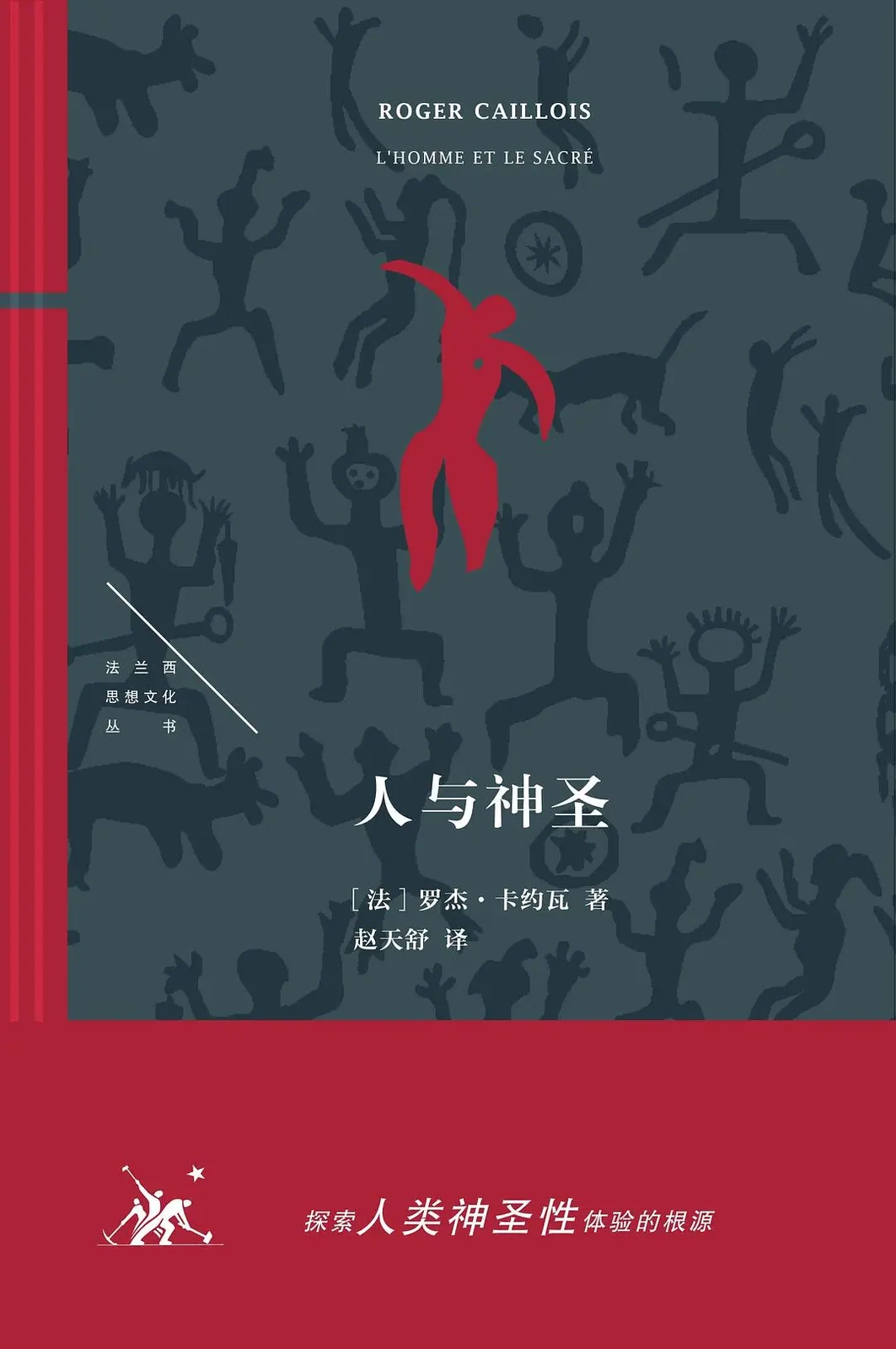
Having taken apart the existing diagnosis, the discussion turned to a constructive search for a way out. Xiaolin Qiu brought in the classical idea of "leisure" developed by the thinker Josef Pieper, as a counterweight to the modern notion of "recreation," which utilitarianism has hollowed out. He explained that this kind of "leisure" is not a pause in work but a stance toward life as a whole, an "all-encompassing regard" for the world and everything in it that one can maintain even in the midst of labor. To turn this idea into a practicable kind of wisdom, Qiu suggested that a "sense of humor" might be an effective path to such a state. Humor has a built-in mechanism of self-detachment. It allows a person, at the very moment they are swept up in the logic of performance, to put some distance between themselves and the earnest, achievement-seeking self, and so to gain a measure of spiritual freedom. Yiqun Wang offered another frame of reference from anthropology: "the sacredness of the festival" in primitive cultures. The festival, as a collective, non-utilitarian carnival, lets individuals temporarily dissolve the small self and join a larger current of life. This stands in sharp contrast to the individualized, atomized existence of modern people, and both points direct us toward a lost, non-functional dimension of existence.
As the discussion went deeper, it moved onto more fundamental philosophical ground, in search of the ontological roots of fatigue. Drawing on the phenomenology of Emmanuel Levinas, Guosen Chen redefined fatigue as a fundamental condition arising from existence itself. On his view, the essence of fatigue is a permanent "disjunction" between the "self" (moi) and "oneself" (soi): the active, forward-reaching intention can never be fully synchronized with the passively enduring, lagging body. It is precisely this internal distance and time lag, which cannot be canceled, that makes up the experience of "being weary of being," and that also makes the "present" possible within existence. Yiqun Wang placed this view in a wider intellectual-historical context. Connecting it with Hannah Arendt's account of the "two selves," he pointed out that this inner "plurality" is both the basis of a person's being a moral subject (I cannot be a bad person whom my other self could not bear) and a structural source of inner tension and weariness. On this basis, Guosen Chen proposed a theoretical turn: to reconceive weariness not as a personal, psychological mood but as a social "affect." Following Spinoza and contemporary affect theory, "affect" is the intensity and energy that circulates and is transmitted through networks of relations among people and things, prior to individual consciousness.
In the end, this new theoretical perspective pointed toward an answer to the question "What should we do?" Yiqun Wang noted that the "deep mediatization" of the digital age is intensifying the "abstractness" of our lived experience and weakening our sensuous contact with the real world, and that this is precisely the breeding ground for social fatigue. So the way out does not lie in escaping everyday life, but in immersing ourselves in it again, in a new way. If weariness is an "affect" that flows through relations, then the way to deal with it is to actively intervene in, rearrange, and create new relations, so as to generate different intensities of affect. This is not a grand blueprint for social transformation but a micro-level, ongoing personal practice: building concrete, small-scale, sensuous new connections with the world by losing oneself in a concert, throwing oneself into an academic conversation, or cultivating a particular hobby. This path promises no once-and-for-all liberation. But on the ground of an existence we cannot shake off, it can, through one concrete "encounter" and "moment" after another, keep infusing a life that has been made abstract with new texture and meaning.
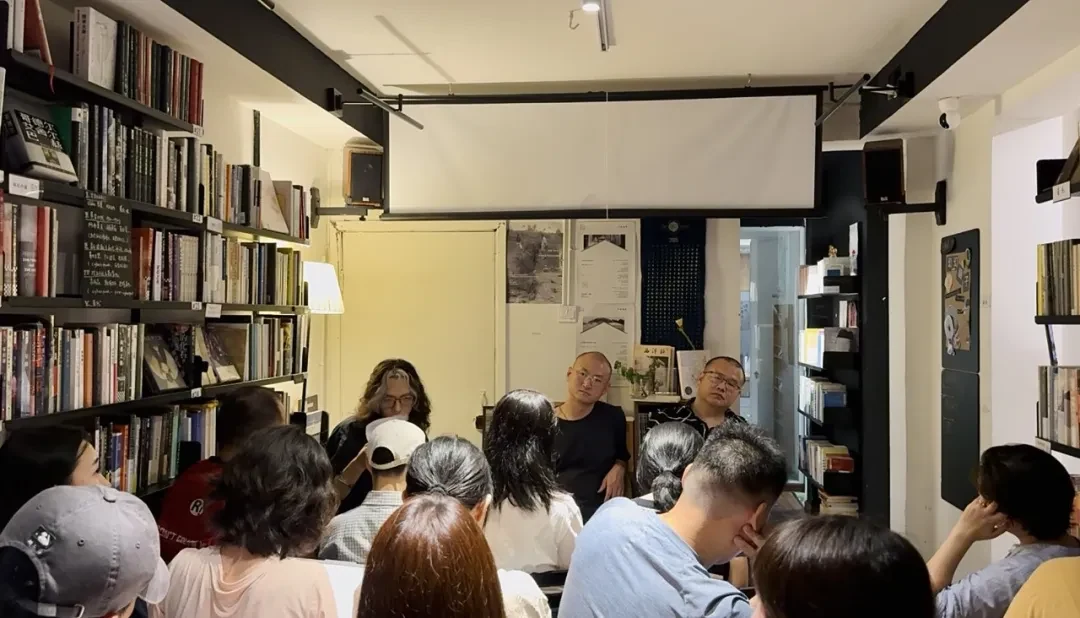
Guosen Chen: Thank you all for coming today. The topic came about like this. A few months ago, when I was chatting with Professor Qiu, he suggested that we find a time to have a conversation. The idea sat on the shelf for a long while, and starting around May we began thinking it over seriously. Then one day this topic occurred to me, because I felt that I was living a very tired life. I started wondering why what I felt wasn't just physical fatigue, and wasn't even the feeling that life couldn't go on, or that I couldn't keep myself alive. It seemed more like something in you was slowly declining. And when it declines to a certain point, by rights it ought to be heading toward some ending, but the ending keeps not arriving, and you just stay suspended in a zone between dying and not quite dead. So I said to Professor Qiu, why don't we talk about "fatigue"? I invited Professor Wang because, from chatting with him before and from sitting in on his classes, I had noticed that he especially likes to talk about the feeling of being blown back and forth through life by the winds of chance, and he particularly likes to talk about Anton Chekhov's stories. As we know, there are plenty of places in Chekhov's stories that write explicitly about fatigue, whether physical fatigue or spiritual exhaustion. But the real reason I wanted to invite Professor Wang is that I feel he himself is very close to a certain fatigue-like atmosphere that Chekhov describes in his stories. Our lives, the state of our existence, the energy and intensity of our lives, are none of them that pumped-up state where you always have to push frantically forward.
Yiqun Wang: Just come out and say I look like someone who tires easily :)
Guosen Chen: Look, I'm half-dead myself. Another reason I wanted this topic is that Byung-Chul Han's book (The Burnout Society [Müdigkeitsgesellschaft]) has become very popular. It's probably his best-known work, and that leads us to the subject of "burnout." So I wanted the three of us to start from a relatively accessible topic or starting point. Because if we launched straight into some other philosophical or literary analysis, it might feel a bit empty, and you might all end up exhausted from listening. So let's begin by talking about what we think of this book.

The English equivalent of "Müdigkeit" in Han's The Burnout Society should be "burnout," which has a specific meaning: a kind of "overwork." Overwork is what happens when work or labor wears a person down to a particular state. But if you look closely, what we casually call fatigue or weariness corresponds to at least three or four words. One is the weariness Levinas talks about in De l'existence à l'existant, which we may get to later, namely "fatigue," which is the same word in English and French. Another is "exhaustion," the sense of being drained or used up, which is sometimes also treated as weariness. Then there is "tiredness," the feeling of being worn out. Today we probably won't distinguish very carefully among these words—if we were writing a paper we certainly would have to—and in conversation we'll basically treat them as one general, self-evident feeling. Let me first ask Professor Qiu what he thinks of this book. How well is it written?
1. The Self-Exploiting Prometheus: Byung-Chul Han's Diagnosis and Its Blind Spots
Xiaolin Qiu: About that book: before we started, Guosen said he had read it once, and apparently never reread it because he didn't find it very interesting. I reread it last night. The book is short, only a few tens of thousands of characters, so it doesn't take long to read. The writing is lovely and full of quotable lines, which is one reason for its popularity; the other is that it hits a sore spot in society. You don't need much explanation of what a "burnout society" is; everyone understands what he's getting at. But one thing needs clarifying. According to the blurb on the back cover, the book understands "burnout society" in a specific sense—namely, our overworked society, and the sense of burnout produced by overworked conditions of work and life. That's the sense in which it talks about a burnout society. But as far as I can tell, Han actually uses "burnout society" in two ways in the book, and you can check this for yourselves. One is the way we usually understand it: we are all living in a burnout society, which needs no elaboration, even though Guosen just mentioned several different corresponding words. The other is a positive sense. In the ordinary sense, a burnout society refers to a negative state; but in the positive sense, it points to an idle, inactive mode of existence. This positive burnout society is a healing state of non-doing, which we'll come back to. He distinguishes these two meanings, and that is the first point I want to make.

While reading last night, I kept thinking of another person's work. Many people may not know this person; in fact I didn't either until recently, when I took part in a friend's family reading group. They were reading this book, which is how I started paying attention to him, and I found that he and Han have a lot in common in the way they put things. He is the German thinker Josef Pieper, and the book is Leisure, the Basis of Culture. I hadn't paid much attention to Pieper before, but when I looked him up, I found that he was actually very influential. A writer you may know better held him in high regard: T. S. Eliot, the author of The Waste Land, who even wrote an introduction to Pieper's book on leisure. In it Pieper touches on many of the sensitive questions we may get to later: what exactly is the cause of our overworked, burned-out society, and what are the possible paths out of it. I think the two thinkers follow fairly similar paths.
But here's the problem. Reading the book, you feel the writing is beautiful, but if you try to share its ideas, there doesn't seem to be much that's new. That was something that puzzled me before I came. I came with high expectations to hear Guosen and Yiqun and see how much they could say on this topic that's new. I imagine all of you are wondering too: what new reading can anyone give of this topic? Our lives, our state of burnout, need no explaining; everyone knows perfectly well why we are burned out. So let's see what you can say. Han does say some things, but I won't go into them yet. Let's wait until we're in conversation and see whether he actually delivers something, beyond the elegant phrasing, that we hadn't realized, or had realized but hadn't thought much about. That's all from me for now.
Guosen Chen: Brother Qun, a few words from you.
Yiqun Wang: It's actually been a long time since I read Han's book. What stuck with me most is the image he uses at the beginning when he talks about burnout: Prometheus and the eagle (or vulture). Prometheus is punished for stealing fire from heaven, and an eagle comes to eat his liver. He says modern people are both Prometheus and the eagle. The eagle keeps pecking, but there is no pain. There's no pain because the two have become two aspects of one person. We keep motivating ourselves—"I can definitely do it"—and that produces the burnout. I had a reaction somewhat similar to what Professor Qiu just described. And not only with Han, but with some of the other fashionable scholars I've read who talk about burnout and the predicaments of existence. For instance, Jonathan Crary talks about how capitalism has killed our "sleep." Let me briefly summarize his view. In modern society there is a force that can dissolve every binary opposition—the opposition between sleep and waking, between work and leisure, between everyday life and festival. Once these oppositions are dissolved, everything tilts toward work and wakefulness. Sleep and festivals alike become subordinate, functional things.
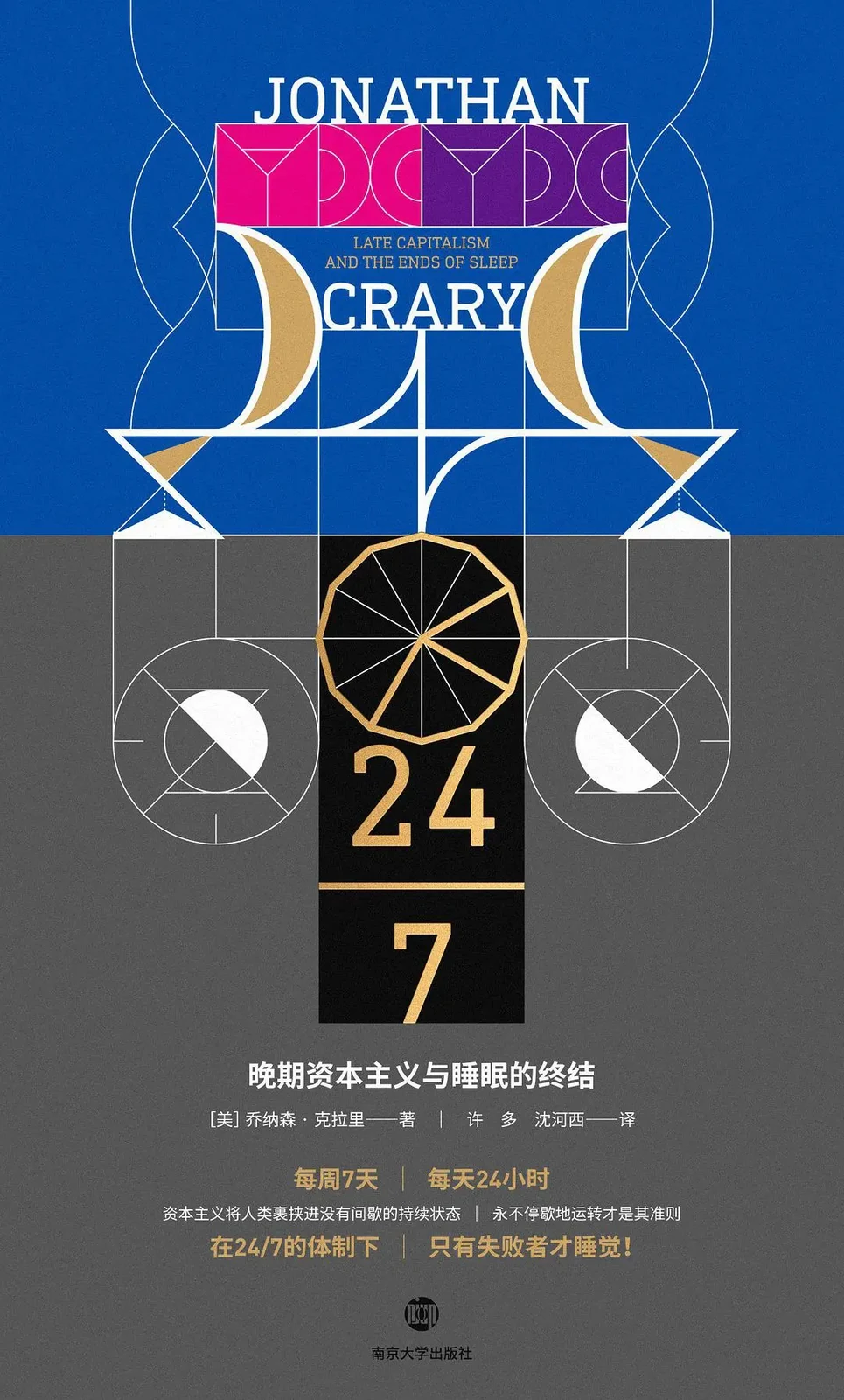
This year I read some anthropology, which talks about the "sacredness" of festivals. I don't know whether the phrase "the sacredness of the festival" calls up anything concrete for you. Reading it moved me a lot. For example, how did people in primitive cultures celebrate festivals? They might spend a great deal of the year in festival—it's said that the Eskimos spend a third of each year celebrating. During festivals they use up nearly all the wealth they've accumulated day to day, singing and dancing, drinking and reveling, defying all sorts of established orders. One anthropologist used the word "de-swelling" to describe their festive state. In everyday life people always have to toil, always get tired, and a lot of so-called "lumps" build up inside them. But during a festival you become another self. I don't have to be someone who calculates rationally every day; I can merge my small self completely into a larger living whole. This in fact expresses what is sacred in human beings. Back to sleep: Jonathan Crary, whom I just mentioned, says that we are now basically always in standby mode, like a phone. Phones these days are never really off, only sleeping or charging, and human sleep has become a kind of charging too. That's also an account of why modern people are burned out.
When I first came across these sorts of formulations, it was like Professor Qiu said about reading Han: the phrasing is very elegant, and it really does, to a large extent, hit on how we feel about existence as modern people. But then you ask: so what? That might be a problem.
Guosen Chen: Thank you, Brother Qun. To pick up where you began: the image you mainly mentioned is Prometheus chained to the mountain, and modern people as both Prometheus and the eagle. From this an idea or concept follows, the "self-exploitation" of modern people. This is because his whole mode of diagnosis in the book is, I think, fairly close to Hegel's: he sets up a unified historical subject and calls it the "achievement subject." The old disciplinary society had all sorts of rules and regulations to guide people in what they should and shouldn't do. Han says that what characterizes today's achievement society is that it keeps telling you "you can" (können), here's what you can do. That is, Han seems to think that it is precisely this excess of positivity that leads to burnout, and that makes people start competing against, or racing against, themselves.
In fact, this is exactly where I think the book's biggest problem lies. First, Professor Qiu just mentioned that he (Han) wants a deep tiredness or boredom, the second sense of burnout. That's like the whole of society being suffused with a kind of... I don't know if you've seen the Peter Handke documentary Bin im Wald, kann sein, dass ich mich verspäte... (I Am in the Woods, May Be Late). In it, Handke lives in a house with a small garden, in lovely surroundings, and the rooms are beautifully arranged—Han is very fond of Handke. Han seems to think that in this kind of so-called leisure and weariness, people will gain a new richness. That's the first point. Second, the reason Han rejects or opposes the achievement society is that he finds it—to use a rather sensuous word—too smooth. It lacks the poetic or heterogeneous element he's after.

But the problem is precisely that Han's own account is also a very smooth model. I think his biggest problem shows up in his attitude toward everyday life as a whole. My feeling in reading this book was that he basically seals everyday life off, treating it as an object with no possibility of rescue. Because on the one hand Han says that our way out is to seek a collective, deep leisure, but on the other he says that the conditions for seeking such leisure no longer exist today. So what are we supposed to do?
So if you read this book alongside his other books—for instance Undinge (Non-things), the last of his books to come out in Chinese, and its essays on the jukebox and various other objects of nostalgia—you'll find that Han ends up arriving at a very negative program: the individual retreats into an idleness that he imagines as aestheticized and as having so-called "depth." But can that become a genuine solution for collective or shared life? On this point, I think Han is in some sense very naïve.
Because he doesn't answer one question (at least as I understand it): if the achievement society drives people to keep exploiting themselves, why is it that, when we work and labor, we can still at certain times feel a sense of accomplishment, or be motivated by it? Second, Han keeps saying that society has shifted from discipline to "can," to the power of positivity. But when this "can" acts on each of us, when we actually throw ourselves into various activities—productive or not—why do we want to do them? Why, much of the time, or at least some of the time, do we have such strong drive to get them done, even if it's repetitive work, day after day?
I think this isn't simply a problem of capitalism, as Han's analysis has it. A better line of analysis would first get down to the individual and ask about the specific mechanisms of motivation, and second, move to the level of community and ask how we might solve the problem, rather than doing what Han does, which is to treat everyone as a single whole. Reading this book can indeed offer some consolation for the so-called feeling of exhaustion, but how far can it actually help you build social relations with other people that are different from before, in real life? How far does it help you discover the richness and plurality of everyday life itself? Because here Han neglects everyday life itself, which is by no means a domain that his Hegelian, ideologically tinged analysis can fully contain. Everyday life always has a certain remainder or excess, something like the "lumps" Brother Yiqun mentioned a moment ago, somewhat imprecisely: an excess that overflows language. This semester I sat in on Professor Qiu's course at Sichuan University on Raymond Williams, and this came up as well. For Williams, one core task of cultural studies is to find out how we actually lived at a particular point in time and in a particular historical situation, and how "the feeling of life" was composed at that time and in that place.
I think this is a different line of thought from Han's. Han's is Hegelian, whereas my position, or my feeling, is that we have to go back to the domain of everyday life. And everyday life always goes on at many levels at once. As I understand it, when you feel weary, is your whole body and mind completely occupied by that one feeling, "weariness"? Or to put it another way, when you're angry, when something gets to you and you lose your temper, aren't there other elements hidden in your emotion, pushing or tempting that anger to turn into some other emotion? It's as if your anger or your weariness is performing at the front of the stage, but is there something else in the background? I think this background element is exactly what Han's account leaves out. In a sense, this is where "potentials" lie. And the potentials still interact with the outcomes that have been realized—whether burnout, anger, or some other emotion. To give an example, take a protest movement that ends in failure. Suppose this protest ultimately fails—do the many and various views that gave rise to it disappear as a result? You'll find they don't. They go on working, as potentials that are bound up and entangled with the outcome itself. And it's quite possible that later on some potential—that is, a possibility that lost out in competition with other possibilities—will actually become real. It's an open process in time, and it's multilayered as well. That's a fairly important point for me. When thinking about burnout, or ways out, or questions of this kind, it doesn't work to reduce them to a Hegelian pronouncement that "history is turning" or "society is turning." If you go in through such a grand entrance, it is actually very hard to find a really convincing program for "what we should do." That's my little introduction.
2. Having Leisure in the Midst of Labor: Humor as an All-Encompassing Regard
Xiaolin Qiu: This is actually an open conversation, and everyone is welcome to jump in at any time. Fatigue is a philosophical topic, but it's also our everyday condition, so dialogue would be the best way to do this. Everyone can tell about their own experience of weariness. So here's the key question. Suppose we basically agree that, whether you look at the overall direction of civilization or at the state of the society we live in, we cannot escape the burnout society—if we can take that as a premise—then what is left for us to talk about? Do we talk about leisure, about what Han describes as the body's idleness and non-doing, the contemplative life, and that kind of self-cultivation without utilitarian motives? If so, there really is nothing new to say, and you might as well all go sign up for a mind-body-spirit course.

On that premise, how else can we talk about it? I think for most people there are only a few paths. If weariness is a state, then its opposite is the state of leisure. How do we get this leisure? As Guosen just said, not only in Non-things but in many of his books, Han actually displays a sense of powerlessness. That is, faced with the miserable state of being stuck in the burnout society, all we can do amounts to a romantic aspiration. So how realistic is this romantic aspiration? I think it depends on the individual's situation. If you're very rich, say, you can be a romantic and live a life of non-doing. If you're very rich and still stuck in the miserable conditions of modern society, then you really should wake up. Maybe after reading Han you'll suddenly see the light: "This is wrong, I'm going to live the right way." And then you're in a position to make it happen, because you have money and can use it to buy leisure.
But if you don't have money, what about leisure then? You might say, let it become a kind of awareness in me, or a limited capacity. For instance, now that I know how important leisure is, I can have five or fifteen minutes of leisure a day to balance out my overworked life. Or I can simply keep up a romantic sort of longing. Apart from these, I don't know what other ways there could be, if we're looking for a path. I'd like to hear what everyone thinks, if you're willing. I think this topic is best suited to a conversation among many voices, not just the three of us talking.
Guosen Chen: Professor Qiu just mentioned "recreation," and that reminds me of something I came across in the past couple of days. There is now a whole discipline called "leisure studies." Since I know nothing about it, I found a paper titled "Why Study Leisure?" to read. They seem to have an enormous system. I skimmed it, and its conclusion is roughly this: the reason we need to study leisure is that the general public doesn't recognize the value of leisure, and so they are unable to take leisure. So we must affirm, in every respect, the significance of leisure for human existence and its liberating power, especially in "resisting the alienation of human beings by technology." After reading it I didn't know quite what to say, so I commented under the post of the blogger who had shared the paper: "All very well said, but the question is, who took my leisure off leave?" Everyone knows this. Who doesn't want to rest and play every day? That paper left me puzzled about the discipline of leisure studies. It has a history of at least thirty or forty years, and since it was introduced into China people have started researching it too; you can find several pages of leisure-studies papers online. But has anyone written about weariness? Is there a "weariness studies"? It seems there isn't.
![Pang Xuequan. Why Study Leisure [J]. Zhejiang Academic Journal, 2025, (04): 130-141+240. DOI:10.16235/j.cnki.33-1005/c.2025.04.018.](../assets/articles/fatigue/13.webp)
Xiaolin Qiu: Picking up on what you said about "recreation," what we were talking about a moment ago was "leisure." A while back I heard a friend give a presentation on Pieper's Leisure, the Basis of Culture, the book I mentioned earlier. When he told us in advance that we'd be reading it, I thought it was strange. Why read a book like that? What can you possibly say on such a topic? How much is there to say about "leisure"? Because we generally understand leisure as nothing more than a substitute state for labor and weariness. I imagine all of you make this switch every day. However little leisure you have, there's always a bit at noon, not to mention festivals like Brother Yiqun mentioned, or the vacations you deliberately schedule for yourself to balance out your weariness. So I didn't know what the book could say. But as I listened, I felt that Pieper really was talking about something I hadn't been aware of before. What he means by "leisure" really isn't leisure in our usual sense, but leisure in the sense of ancient Greek philosophy. What is this philosophical sense? Let me start with a particular person.
We know that in China, during the decade or so from the late 1990s into the early 2000s, there were many debates in intellectual circles—liberalism, nationalism, populism, the New Left, and so on. Probably the most contested was liberalism. Looking at the intellectual situation in those years, liberalism was fairly dominant, because the market economy was doing well at the time, and liberalism was obviously the ideology or system that went with it. But plenty of people disliked liberalism. Apart from the New Left's critique that liberalism was the same thing as capitalist exploitation, there was another voice, which came from a more conservative, classical understanding of "freedom," and its representative figure was Liu Xiaofeng. Liu Xiaofeng once gave a lecture at a research center at Shanghai University in which he attacked Ang Lee's film Lust, Caution. He argued that we had misunderstood freedom, thinking that freedom means that the melodies of all our various life-desires can come on stage on an equal footing.

Everyone knows Lust, Caution, so I won't go into it. You can all see what he meant: he thought Lust, Caution was a very base film that seemed to want to use base values to undermine the moral cause of the revolution, and he thought Ang Lee was a deeply immoral director. Here he wanted to distinguish what true freedom is. He held that freedom is not coming on stage as equals. When we talk about liberalism, one of its core ideas is equality of rights, as everyone knows. Of course liberalism has many other meanings, but here we'll only talk about equal rights. Under this idea there is no distinction between high and low, refined and vulgar, and all of this is bound up with freedom. He, by contrast, held that in ancient Greece freedom had a specific meaning, and that meaning was "leisure." What does leisure mean? Only those who think about questions of the whole—to put it bluntly, philosophers like Plato—deserve to have leisure, to think freely about the world. That's how freedom and leisure were linked.
Coming back to the point, this is how Pieper understands it: leisure is not simply a relief from or switch away from weariness. It's not, as Brother Qun put it, like a phone charging in sleep mode. Our leisure seems to exist only to recharge us for labor, as in the Frankfurt School's critique of the culture industry, which held that it just lets the working class recharge and rest a little so they can go back to work. Pieper thinks it isn't like that. Leisure is an entirely different state of being, an attitude of regard toward the world. What kind of attitude? An all-encompassing one. To be honest, put this way it sounds abstract not only to you but to me as well. Today I even spent a while talking with GPT, asking it to explain properly what Pieper means by "seeing the world as a whole." It gave me some examples, which may sound a bit silly but actually make some sense. Namely, don't just bury your head in one task, but while doing it, see many other things too. For example, when you make a cup of tea, it's not just to quench your thirst; you may have forgotten that you can stop and watch the tea leaves slowly unfurl in the water—that kind of somewhat chicken-soup-for-the-soul thing. These examples may not be very interesting, but what I want to say is that through examples like these you might get some sense of what he means by "an all-encompassing regard for life." That is, what Pieper is talking about is being open in every dimension, especially in your senses and your consciousness.
So what is the first consequence of this? It's that you don't necessarily have to stop working to get leisure; you can be in a kind of leisure even while you work. Staying in all-round contact with, and open to, the world is itself the state of leisure. I think that only if we put it this way can we find a little bit of a way out through leisure. Because we all know we can't escape the burnout society, and we feel that the direction in which civilization is developing will only make us more and more tired. If we're talking about a way out on the premise that leisure can only be bought with money, or that it can only come as a five-minute switch, that's enough to make anyone despair. Only one way of thinking about leisure strikes us as at all interesting, and that is: having leisure while we work.
How do we do that? What Pieper really means is to stay in an all-encompassing state of contact and connection with the world. What kind of state is that, exactly? Brother Yiqun just talked about primitive peoples' festivals, and Pieper in this book and Han in The Burnout Society both talk about this too: leisure is a festive state. And the festive state, as Brother Yiqun just said, lets you step out of the small self and connect with a larger life. To put it bluntly, don't always stay stuck in your own little plot of land; come out and look at a bigger world. This doesn't mean abandoning your own little plot, but realizing that beyond it there is a much wider world. If you have this kind of awareness of life and this stance of regard, then leisure can become a way out for us amid labor we cannot escape.
Understood this way, it may be somewhat interesting, but you may still find it rather mysterious. Let me put it more plainly. It's really a kind of wisdom we often talk about, the idea of "coming out from inside and going in from outside." That's easy to say and very hard to do. I want to give an example from a book I happened to read these past few days, which is very interesting. The book is Carl Jung's Analytical Psychology: Its Theory and Practice, and it's a delight to read. It consists of five lectures Jung gave to a group of psychiatrists in London, along with his discussions with the doctors afterward. In this book you get a flesh-and-blood, very well-rounded picture of Jung, which is really fun. What I'd read of his before were purely theoretical works on psychology and literature, nowhere near as interesting as this book.
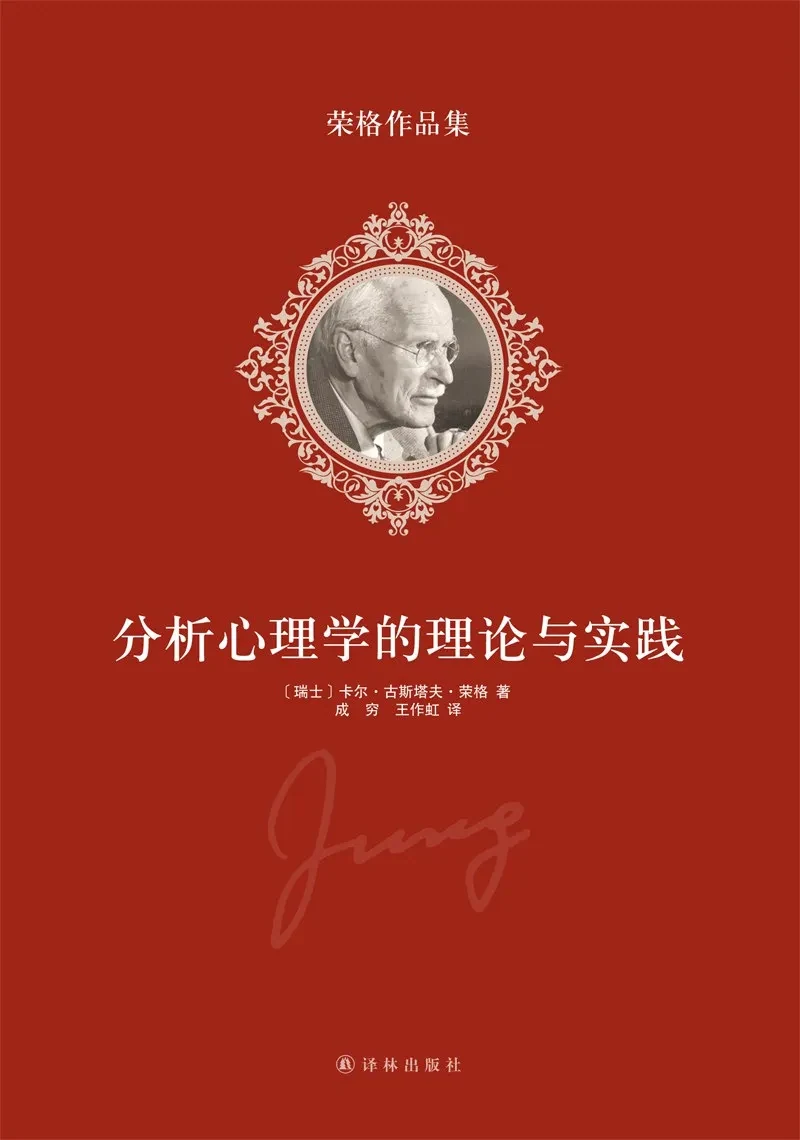
In a moment I'll read you a very interesting passage from Jung. But first I want to read you a couple of sentences from the chairman. Before each lecture a chairman said a few brief words, and what the chairman of the second lecture said is especially interesting. I don't think Jung himself grasped how subtle the chairman's remarks were. In the first lecture Jung discussed several states of human subjectivity: sensation, thinking, feeling, and intuition. Jung divides human subjectivity into these four states; I won't go into the details here. Then the chairman says: "Professor Jung spoke of these functions, and I have the impression, contrary to what he told us, that all of these functions seem to be perfectly clearly distinguished in his own mind." That's an odd thing to say. Jung spent a whole evening explaining these four functions to everyone, the four forms in which subjectivity manifests, and the chairman says "it seems these functions are perfectly clearly distinguished in his mind." Hadn't Jung distinguished them clearly? He talked about them the whole previous evening, and there was a lot of discussion afterward.
Let's look at what he says next: "I also have a feeling that in his mind these functions are all connected to one another around a sense of humor as their axis." Now that's really strange, because you have no idea where the word "humor" suddenly came from. Jung never mentioned humor earlier, and after the chairman said this, Jung never took the matter up either. Yet the chairman says that everything Jung said about the functions of the subject was connected around a sense of humor as its axis. Then he goes on: "No truth that any concept possesses would convince me so much as the ability of the person who put forward those concepts to treat them as a subject for humor, and that is exactly what Professor Jung did last night." But if you, like me, read the first lecture and his exchanges with those psychiatrists carefully, you'll find that Jung didn't do this at all, because he didn't talk about humor at all. And especially the last sentence, which is just wonderful: "Being too serious about the subject one is studying often betrays one's anxiety and uncertainty about the truth one is so strenuously trying to proclaim." That's a brilliant sentence.
What he means, I think, is perhaps to give Jung a friendly reminder: don't take it so seriously. You explained it very clearly, it's very clear in your own mind, and you're sharing your psychological ideas with us very earnestly, but without a sense of humor, all this talk isn't really worth much.
I think this is what I want to use to illustrate the point I first raised from Pieper: can we, while working, still keep an attitude of all-encompassing regard, a way of being with the world? Quite possibly, apart from the rather mysterious things he talks about—opening our senses and our thinking to the whole world—the thing we can most readily put to use, that we can grasp at once and put into practice, might be "humor." That is, we can go about things very much like the "achievement subject" Han criticizes, while keeping a sense of humor. A sense of humor is itself a way in which the whole looks down upon and surveys the part. I think this may help us grasp what he means by "all-encompassing regard."
Guosen Chen: There's a joke about Hermann Hesse. Didn't he have some mental trouble? So people said: he was unlucky because he had mental problems, and lucky because his psychoanalyst was Jung. And Hesse ended up living a long life, into his eighties.
Audience Member 1: Professor, may I ask a question? You talk about burnout—could its opposite be not leisure but passion? Leisure is just one path. Because once you have leisure, you may still be anxious. For instance, I find work exhausting and want leisure, but when I have leisure I'm still anxious. But if you have passion...
Xiaolin Qiu: Here's the thing. When we look for a word's counterpart, we find that, at least in Han's context, this burnout is caused precisely by excessive passion. There's a term in his book, as Guosen said, "self-exploitation." Self-exploitation is very passionate: "I'm going to get this done!" Say you go for a long run today and run 10,000 meters, and you think, no, my limit is probably 12,000; you run 12,000, and you think, no, maybe I can exploit myself a little more and get to 14,000. That's very passionate. So passion and burnout here are cause and effect: it's precisely this excessive, self-exploiting passion to tap your own potential that leads to burnout. So the opposite of burnout can't be passion; it's idleness and non-doing.
Audience Member 1: What Professor Qiu said about humor really struck a chord with me. It's true that many of my colleagues often complain about illogical rules and regulations. But you'll find that if you let people step a little outside that order and poke fun at the thing by analogy or by twisting it, they get a great sense of relief. In that instant you feel you can temporarily detach yourself from this tedious order and get a kind of pleasure. Besides having that function, I think humor is also something aesthetic to be encouraged. It's non-utilitarian, it doesn't make you take part in direct interests; you temporarily peel yourself away from it, and get what seems to me an aesthetic, temporary escape. Of course this aesthetic also brings spiritual pleasure. Apart from that, I personally feel—like when I read Eugene Onegin some time ago, the hero lives an aristocratic life and is very idle every day. There's a passage describing how in his thirties he often plays cards and billiards with friends, entirely in a so-called state of leisure, yet he's still deeply weary and can't work up interest in anything. I think what's missing behind it may be a support of meaning. All his ways of passing the time are temporary fillers of the senses; none of them lets him find something that gives a wholeness of value. The organic quality of his life has been destroyed. Instead, when later in life he falls in love with the heroine again, his life is full of passion once more; he writes letters madly, courts her, never tires of it, and his weariness vanishes in an instant.

Xiaolin Qiu: But Tatyana turned him down. And we can predict that if Tatyana had accepted him, he would soon have sunk back into burnout.
Audience Member 1: This may have to do with our taking a life structure like Robinson Crusoe's as a point of reference for ourselves. We often fantasize about going off to an island, herding sheep, or doing something closer to nature. Behind this may be the idea that you want to find some meaning in a more whole environment, and that meaning is exactly what's missing from our trivial everyday work. You can't find anything you endorse in the orders others hand you, you keep fighting against some value of your own, and then it's not just physical weariness—more and more waste builds up in your spirit too. If you could be like Franz Kafka and use your hours after work to keep writing, maybe that would in some sense fill this feeling.
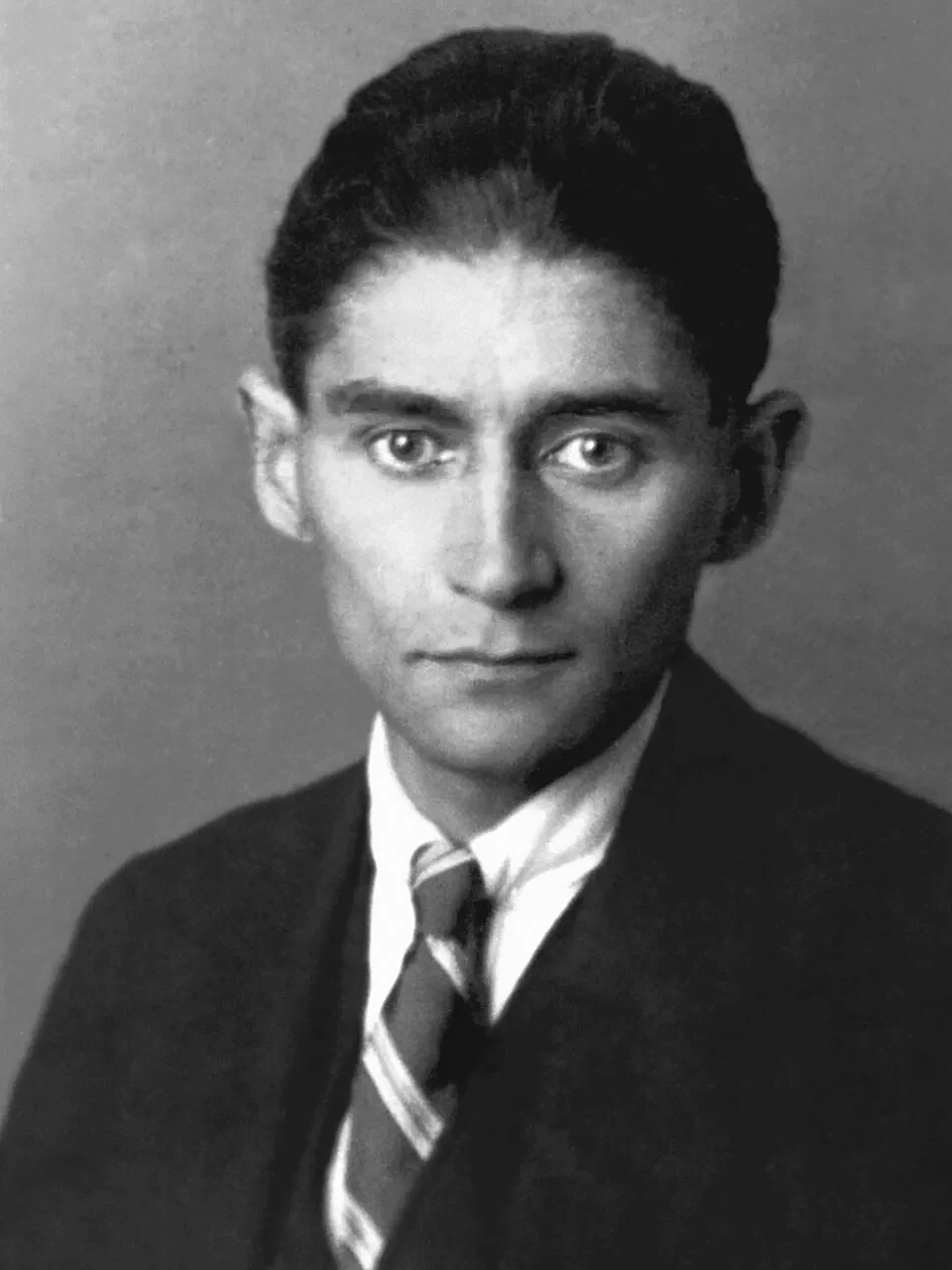
Xiaolin Qiu: But Kafka had it very easy. He was actually a senior clerk at a workers' accident insurance institute, and he got off work at three every day. And whenever he didn't feel like working he could ask his superior for leave, and his superior would grant it.
Guosen Chen: But in a sense Kafka also created what may be the greatest spokesman for burnout in all of literary history—Gregor Samsa. You can think of him as someone with a chronic inability to get out of bed: because he woke up one morning not wanting to go to work, he turned into an insect, and never had to go to work again.
Yiqun Wang: The person who had the hardest time getting out of bed is Oblomov. The novelist Ivan Goncharov devoted an entire chapter to how hard it is for him to get up.
Xiaolin Qiu: Those articles Guosen sent me mentioned a great "literature of the bedroom," right? Bedroom literature is entirely about people in this state of weariness.

Yiqun Wang: Onegin's problem, which came up just now, actually touches on some other causes of modern weariness—our basic existential situation, for example. To put it bluntly, if we're naturally uninterested in a lot of things, or lack an all-embracing direction of meaning (intentionality) that can carry through many years, we'll naturally tend to feel weary. Among the protagonists of modern novels, you'd be hard pressed to find one who doesn't feel weary at some moment of his life. These past few days I've been reading the Sherlock Holmes stories, and I've found that Holmes is actually a very modern figure, with a strong sense of nihilism. He periodically sinks into an enormous, inescapable melancholy, lying on his bed or sofa, barely eating or drinking, not speaking to anyone. He has two ways out of this predicament: one is injecting cocaine, the other is waiting for a murder. He says that "the tangled skein of everyday life is pale and colorless, and murder is the dark red thread running through it." As soon as a murder comes along, he perks right up. But however bizarre the case, once it reaches him and goes through a bout of rational disenchantment, it turns out to be nothing but the usual clichés of love and hate. So everyday life is still flat, and he sinks back into boredom and melancholy.
Audience Member 1: As a detective, his job is precisely to work out what can't be seen in life. He has to see the whole behind everyday life, and that's exactly where his pleasure lies. That's actually the same as our lives.
Yiqun Wang: Let me add a couple of things about the concept of freedom Professor Qiu just raised. It reminds me of what Maurice Merleau-Ponty says about freedom. Of course the freedom here isn't political freedom but a state of life. That is, in what sense do we think a person is free? If we think people are purely free, or that they are entirely constructed by others, both claims are equally meaningless. So what does he say freedom is? Phenomenologically speaking, freedom can only be a person's transcending of a certain situation. When we transcend a situation, we become someone else, but not entirely someone else, because we still retain our own identity. I think this is meaningful for understanding Han's thought as well.

Guosen also mentioned that Han's analysis has many gaps—for instance, that when we act there are other existential moods besides weariness, and that he simplifies contemporary life. But I don't think we need to read a little pamphlet like Han's as a rigorous work of thought. He may just want to pull out one aspect of everyday life and highlight it, as a kind of warning. It's true that in everyday life—take the leisure we were just talking about—I may have plenty of leisure and still find my leisure exhausting. Say I watch a movie: five minutes in, I know it's a terrible movie, yet I somehow watch it all the way through. Afterward I feel awful—120 minutes just gone like that. I think it serves as a reminder that, at least in some corners of life, we could live with a bit more "leisure." So maybe after reading Han I've watched fewer bad movies.
3. Weary of Being: "The Present" Lags Behind Itself
Guosen Chen: Following on from what Brother Qun just said, his mention of Merleau-Ponty raises a question for me. In a certain sense, the freedom Merleau-Ponty describes seems very close to Levinas's definition of fatigue. Of course the two are dealing with completely different problems. Merleau-Ponty talks about this "freedom in situation" in order to oppose the mechanical view of freedom in scientistic determinism, as well as Sartre's view of absolute freedom. Levinas, on the other hand, talks about "weariness" in order to bring out the temporal structure of the being of the existent, the existent that has broken free of existence. In Existence and Existents he says some very startling things, for example: "To be weary is to be weary of being." That looks very profound, but on its own the sentence is baffling. He even says "fatigue is a curse," but at the same time he says "effort is also a curse." Of course, if you just read these as literary turns of phrase, they aren't hard to understand.
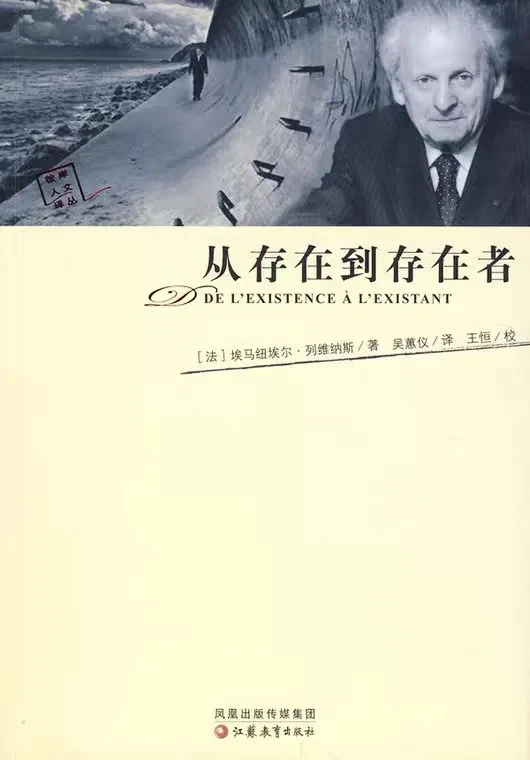
Why do I say this reminds me of Levinas's account of weariness? Because just before the sentence "to be weary is to be weary of being," there's another sentence. Let me read it: "A being endures the disjunction between the self (moi) and oneself (soi), unable to meet itself in the instant." And then he says: "The almost self-contradictory moment in the self—the present lagging behind itself—cannot be anything else; it is weariness." What does this mean? As I understand it, this "present lagging behind itself," and the earlier "disjunction between self and oneself, unable to meet itself in the instant"—this distance or lag is what he names weariness. If we don't interpret it within Levinas's framework and don't drag in terms like "existence" or "il y a," it seems we can understand it simply like this: our existence always has a tendency to rush forward, and this forward-rushing self that we envision can be called the "self" (moi); but at the same time there's another being that isn't in sync with the "self," that's always dragging you down from behind—a bodily bearer, a me not yet actualized—which Levinas calls "oneself" (soi). It's precisely this disjunction between "oneself" and the "self" that produces weariness. Because the two can never coincide.
What would happen if the "self" and "oneself" did coincide? If the two met in the instant and overlapped, then the so-called "present" itself would become impossible. You can imagine that if that really happened, you'd become God: whatever you wished would come true, whatever you thought of would be realized at once. That's magic—he talks about magic at the very beginning of the first chapter. Our existence isn't magic. Our existence, at every instant, is held up by the disjunction and distance between "self" and "oneself." It's something thick and sluggish. It's precisely in this disjunction between "self" and "oneself," in the state where "the present lags behind itself," that we carry out our existence and our being. That's why he says weariness is a curse, that "to be weary is to be weary of being."
Of course, to explain further, what he calls "being" refers to the process by which a person breaks free from the impersonal, what he calls the anonymous "il y a" (existence), and becomes himself, becomes a subject. The state of life that comes after this process is what's called "being."
Xiaolin Qiu: So his Existence and Existents is brilliant, but it really isn't easy to understand. Some everyday examples might help explain it. What he says is that weariness is a momentary consciousness, "weary of being," and this "weariness of being" is realized in an instant. Let me give an example—it may not be quite apt, but it's one from my own experience. When I was in high school, the school held a sports meet, and one event was the 1,500-meter run. The race was about to start, and the classmate who had signed up for our class was nowhere to be found. I don't know what came over me, but I said I'd do it. At the time I had no idea of my own ability as a distance runner, because I'm terrible at distance running and my heart rate runs high. So I started running, and for the first two laps—I remember it was a 200-meter track, so seven and a half laps—I was out in front and felt great. But on the third lap I started gradually falling behind, and around the start of the fourth lap I suddenly realized that I was running, that I was in a race. Before that I hadn't taken it seriously at all. And I realized there were still several laps I had to finish.
For me that was a momentary consciousness. I was, as Levinas puts it, "riveted to being"; at that moment I was riveted to the task of "having to finish 1,500 meters." Yet every step felt like a huge effort, every step lagged behind my goal, and that's true weariness. I imagine many of you have had this experience: when you're doing something that takes a lot of mental or even physical effort, at first you don't realize how hard it is, and it may even be going fairly smoothly, but as you gradually run into difficulties, you suddenly realize, "Oh, I'm doing this thing, and I have to finish it." Now it's gotten hard. At that point, I think, the feeling of weariness arises. And our existence is like this, because if we don't want to die, we have no choice but to exist. A lot of the time you realize, "I have to go on living." That's what Levinas means: being riveted to being is a curse. What he calls a curse is that you have no choice but to exist. You already exist, and so you have no choice but to go on existing.
You can't just sit forever; you can't not sleep, you can't not eat. And if you sit too long, your body starts breaking down. In short, you have to do all sorts of things; you have no choice but to exist. So his word "curse" sounds a bit exaggerated, but if you think about it, that's just how it is, unless you choose to die right now.
Guosen Chen: That's why Levinas quotes a line from Baudelaire: "Good God! Tomorrow one must go on living."
Yiqun Wang: That's exactly the feeling. What you said just now about the relation between "I" and the "self"—it suddenly strikes me that behind it there may be a very deep metaphysical tradition in Western thought. When we say we should listen to the voice of the self, we don't mean being self-centered; we mean that each of us actually has two selves in us, and we have to get them to live in harmony. Hannah Arendt paid special attention to this. She says that even when a person is alone, there is a kind of plurality. Take the moral level, for example: why don't I want to be a thief? Even if no one would see me steal and the police could never catch me, why don't I do it? Because this "self" has another "self" it can't shake off. Arendt says you can't get rid of him, you can only live with him for the long haul, and this self won't like a person who steals, so we don't want to do bad things. She also says that the reason many Germans were able to keep their moral integrity during the Nazi period was precisely this: "I can't do this; I have to live in harmony with my other self." There may be an implicit relation of urging, of pressing, in this. I ought to do this—as Professor Qiu just said, I ought to keep running, I can't stop. That's why you get weary.
Guosen Chen: Let me show you a meme: this is roughly what it feels like when you haven't had enough sleep—my body and my mind are offset by about five centimeters, and there's about a three-second delay when I move. I don't think the two selves are necessarily fully equal; the thing is actually a bit like what he's drawn here, and that's the feeling of weariness I have in mind. Your life can't have the self and oneself overlapping at every moment.

Xiaolin Qiu: It sounds contradictory, as if "I" and "I" are at a distance from each other. Put more plainly: there's a gap between bodily feeling and consciousness. Jung has a view that primitive people didn't have what we'd call an empty consciousness; it was all bodily sensation. Of course that's just Jung's claim, and we can't know whether it's true. But if it is, it means there are some things in us that can't be fully assimilated at the level of consciousness, and then the idea that we're offset from ourselves makes sense. Jung even says that consciousness is an unnatural effort, because he thinks our most fundamental and real being is actually the unconscious, and consciousness is just a little bit that pokes up out of the sea of the unconscious, and a very unnatural effort at that.
Yiqun Wang: When I have an 8 a.m. class, I set about twenty alarms for myself. Every time an alarm goes off, there's a self struggling to get up and a self that can't move.
Audience Member 3: I'd like to make a point. Everyone here may be a bit dismissive of "mind-body-spirit." I'd never had any contact with that school before, and I also thought there was something off about it, but some of its theories, I think, connect with our discussion today and could be useful. For instance, we just said that being fatigued is being "weary of being," and being "weary of being" could be described as a state of not wanting to exist. And the root of not wanting to exist may very well be that you aren't being yourself. That is, you may have a big self and a small self, and they're—not broken apart, but not aligned. You aren't doing what you really want to do; you may have become the person others want you to be, rather than the "me" you yourself want to be, and that's what leads to weariness.
Then there's the passion we were talking about. The passion just now meant a state of "involution," the rat race: you run 1,000 meters, then you have to run 1,400. But that may be because of someone else's demands, or because you yourself want something—you want to be healthy, say, so you have an external demand, and then you do the thing. When you're done you may not have gotten the result, or it's not what you expected, and then you get weary. But if it comes from your own heart, if what you most want to do right now is your passion—"I just want to run right now"—then even if you get nothing in return for it, you'll feel happy and glad, and the running may not produce weariness. Maybe that's the idea: if you do something that excites you, something you most want to do right now, you actually won't get weary. In our way of life, "weariness" may be close to "involution," and what we call "recreation" or "rest" may be a bit like "lying flat." But there's another way of life, which is choosing to do what you like, what you love. That way you might not get weary. If you're doing what you like—say, playing games for twenty hours—you may still feel pretty happy and excited afterward; but if you work for twenty hours, you'll definitely be exhausted.
Xiaolin Qiu: Is it possible that you set yourself a goal—I'm going to play games for twenty-one hours—and then you get burned out?
Audience Member 3: Right, if you have that kind of goal, it's not coming from your heart. If there's a demand, whether from society or from other people, and you're doing something not because you want to but because someone requires you to, you may be more likely to get weary.
Xiaolin Qiu: Han's view that our society is no longer a disciplinary society is open to debate. What he means is that it's not that others tell you what to do, but that you keep making demands on yourself; you're in a rat race with yourself. And what you just said is that "mind-body-spirit" is about finding yourself, and as long as you've found yourself, however hard you work, you won't seem to get weary. But how to distinguish between the two may be a problem.
My view is that I don't particularly agree with this idea in Han's book. Maybe that has to do with the question just raised. Motivating ourselves at work and searching for the self in "mind-body-spirit" both seem to be about looking for the self; in both cases you're making demands on yourself. Han thinks we're no longer a disciplinary society because we motivate ourselves and let the passion of the self drive us on endlessly. But I think he's too optimistic. In fact, all of you here may on the one hand really be in this state of self-motivation, constantly making demands on yourselves, which in some sense comes from an inner desire to do things well. I read an article some time ago analyzing The Lychee Road, which was quite illuminating. I haven't watched the TV series—it's too long, I watched a little and didn't finish it—but I know the story. Li Shande has to carry out the task of delivering lychees to the Imperial Consort. It's an order from the emperor, an external discipline. But the article's point was that, beyond the external order, once he has no choice but to carry it out, he, as an "imperial calculator," tries every method he can think of to get the lychees to Chang'an in the shortest possible time, and in the process he feels a kind of excitement. That process is actually a bit like the self-exploitation in our society today. You're given a task, which was originally an external discipline, but once you accept it, you, like Li Shande, feel you're doing it willingly. In officialdom, for example, some technocrats receive instructions that may seem hard for us to understand, but in order to do the job as well as possible, on the basis of rational calculation, they go about it almost with passion.

Here is something where I don't quite agree with Han. There's a connection between external discipline and self-motivation. I think our society today is still a disciplinary society. I don't know whether you two agree with me, because Han thinks we're not. I think even in Western countries that have developed into post-industrialism, it's still a disciplinary society; that's a deeper ecological background. You could go survey the employees at big companies there, the big tech firms, and they all seem to be exploiting themselves in what they do, but in fact you all know there's a cover over them from outside, and that's what disciplines you; you can't break free of the most fundamental constraints. So in that sense, perhaps we can, in a way, distinguish the self-seeking of the achievement subject—what he calls the subject that pursues merit and performance—from the self-seeking of mind-body-spirit that you're describing.
4. Social Affect: Weariness as a Structure of Feeling
Guosen Chen: Let me add something to what Professor Qiu said. About this matter—including the excitement Li Shande feels, and including what Brother Yiqun just described, Holmes's pursuit of high-intensity things like solving cases—what does it all mean? Since we think Han's understanding of burnout is flawed, within what scope and to what degree should we give it a reasonable explanation, and ideally find a way out? I'd been thinking about this question for the past few months, until the other day I found a rather interesting angle: Spinoza's definition of human existence and human essence.
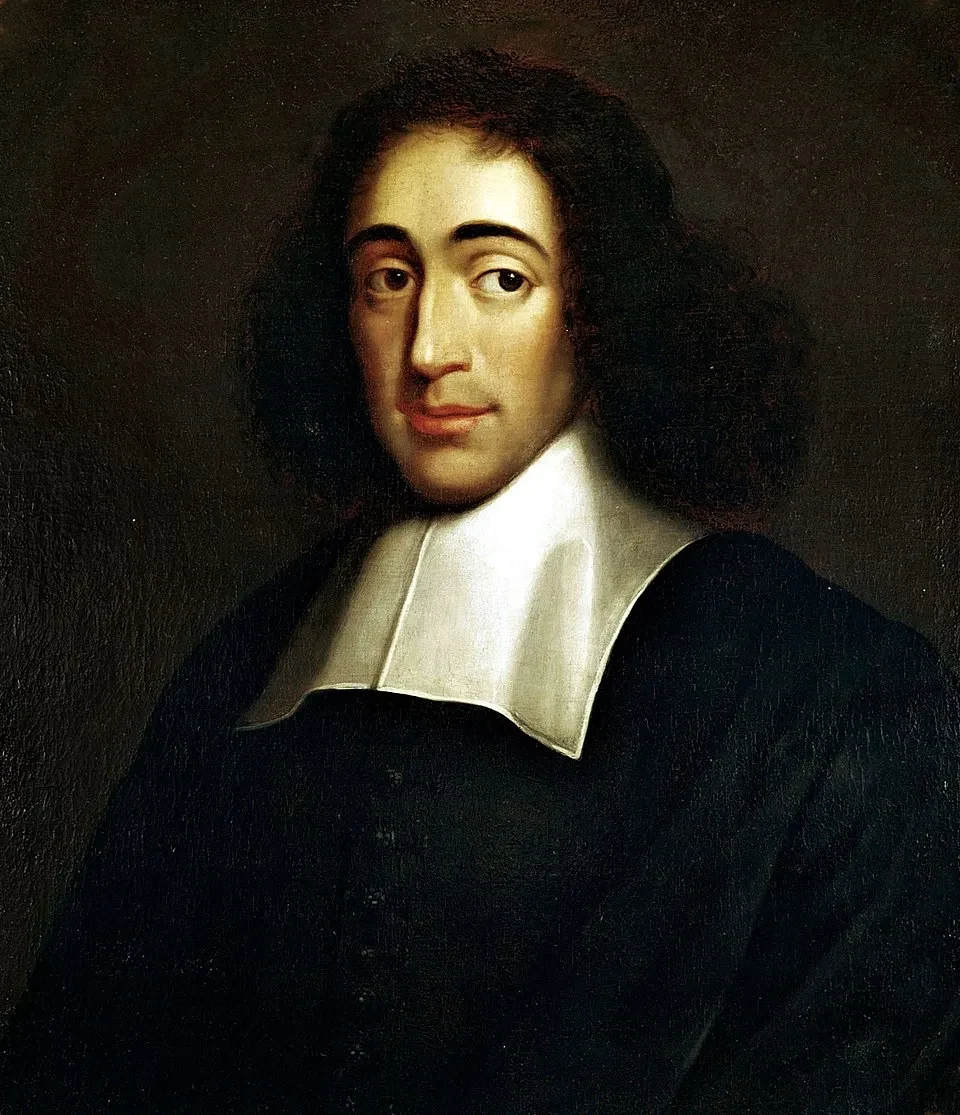
Professor Qiu just mentioned Jung's claim that primitive people had no blank consciousness, only bodily sensation. In a sense, Spinoza actually held that the essence of a human being is what he calls conatus, which translates roughly as "the striving to exist" or "natural power." What does that mean? Conatus means that people constantly strengthen their own capacities; living beings have a tendency to keep increasing their various powers. Whatever that power is, at the starting point it has no direction. And your feeling happy or sad, all the activities you carry out in the world, are based on the increase or decrease of this power. This activity has a fairly well-known name in cultural studies now; in English it's affect, which in Chinese can be translated as "情动." So "affect," in this sense, is intensity, pure intensity. I think this may be a good way to define and get a grip on the feeling of weariness. Because affect is a very interesting word. First of all, your happiness and sadness are not themselves affect, because affect is an intensity that has already acted on your body before emotions like happiness and sadness arise. It's pre-emotional, pre-feeling. What we call feeling or emotion comes after affect. When we talk about affect, we also say that you as a person have the capacity to affect and to be affected, and that too is "affect." So it has a strong quality of in-between-ness.
What follows from this? "Affect" is actually transmissible. It doesn't just happen inside your own body; it flows and oscillates continually through the network made up of people and people, people and non-humans, people and matter—you could call it a cluster of relations. So I think weariness seems to be this kind of feeling. Much of the time you feel weary not merely because your own body is telling you "I'm tired." More often, even when you're relaxing, the weariness is still there. Even if it isn't happening in you personally, it may very well be happening in your relations with other things. In this sense, weariness may be a social "affect." I don't know whether that would be a more fitting way to put it. That is, it's not an emotion at all, not a feeling; it comes earlier than those things, it's more primordial.
And the relationship between "affect" and emotion is fairly complicated. When Professor Qiu was talking about humor just now, I thought of how I feel watching stand-up comedy. When you watch stand-up with other people, you're always a bit happier than when you watch a video at home by yourself. Why? When I go see some performers and they tell a joke, I haven't even understood it, and I've already started laughing. It doesn't seem to be because you see others laughing and think you ought to laugh too; it's that you're laughing along with them. Even before your brain has figured out what's funny about the joke, you're already laughing with everyone, and only afterward does it dawn on you, oh, so that's what the punchline meant. That too is an intensity that comes before emotion. Brian Massumi has an important essay that set the direction for affect studies, called "The Autonomy of Affect." In it he gives an example: he showed different films to a group of nine-year-olds and then had them vote on which version they liked best. Interestingly, many of the children voted for the ones that made them sad. The conclusion was that when people watch sad films they actually feel pleasure and like them. That seems to be a contradiction: why should something sadder give us more of a certain kind of pleasure? You'll find this can't be resolved at the level of emotion. But from the standpoint of affect, it's because the intensity you feel in the sad film is higher, higher than... because they showed different kinds of films...
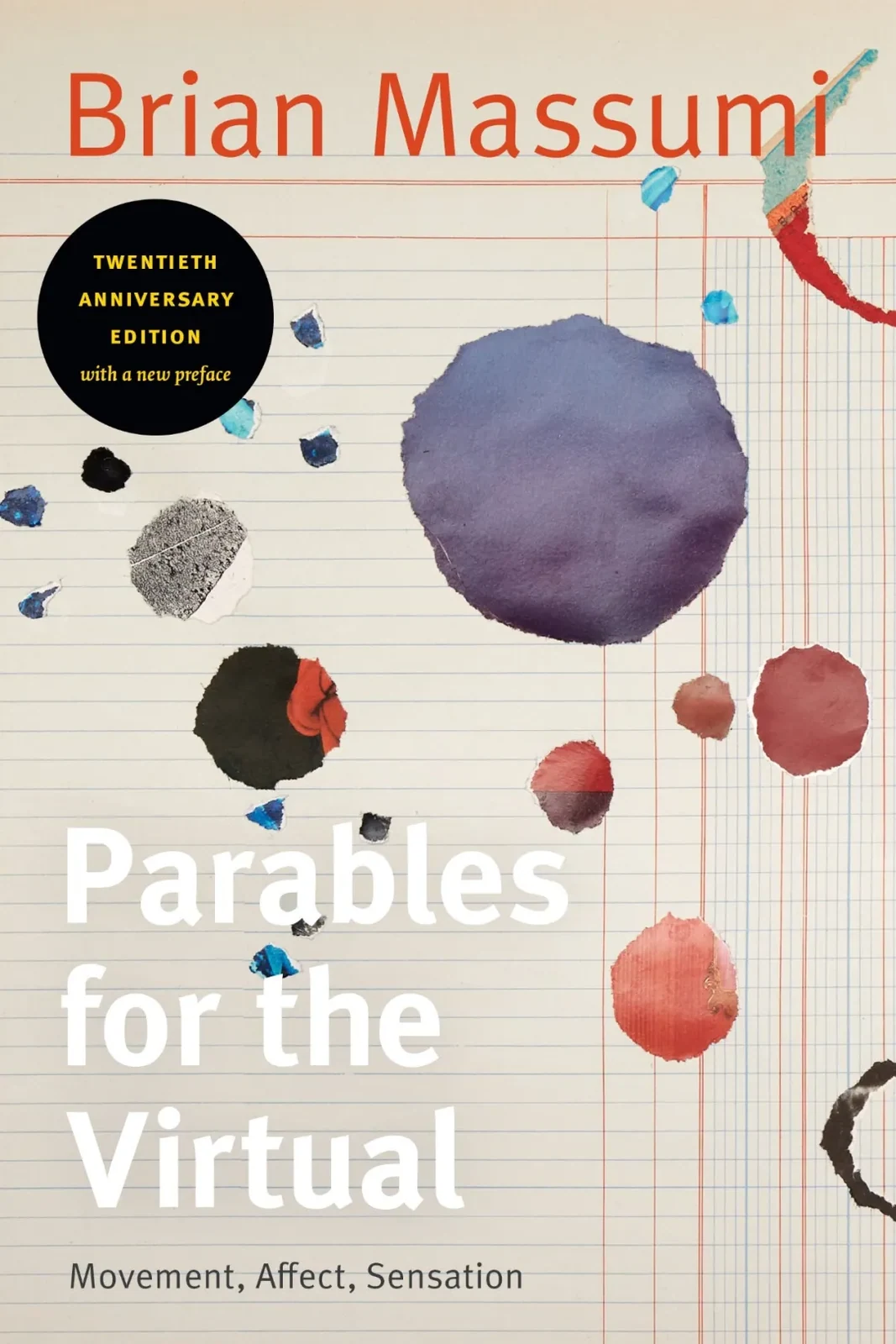
Yiqun Wang: Let me interrupt—could it be something like this? For instance, I pick the sad film over the happy one because, when it comes to voting, the sad film may seem more sophisticated...
Guosen Chen: These were nine-year-olds. And there was a control: one film was an explanatory version with voice-over, the other the kind we'd call immersive.
Xiaolin Qiu: Let me cut in. Actually, I was quite surprised at first that Dead to Rights (Nanjing Photo Studio) did so well at the box office. I think it may have something to do with what you're saying. Because I assumed a film like that wouldn't do well, and it ended up doing extremely well.
Guosen Chen: Back to the question. If, as I just said, we understand weariness as a social affect, then in a sense Raymond Williams's "structure of feeling" is a concept with a very affective character. Professor Qiu mentioned it earlier when talking about modern discipline, but Williams's "structure of feeling" is very hard to explain clearly. Why? Because he keeps elaborating it across several books. If you misunderstand it, the concept of a "structure of feeling" can seem to turn into something like Hegel's "spirit of the age," but it's completely different from that. Williams wasn't a philosopher; he did cultural studies, and in many of his books over his lifetime he kept revising and reinterpreting the concept of the "structure of feeling."
Since we want to consider weariness in terms of affect—that is, as something extra that overflows in a network of relations, a surplus, remainder, abscess outside the realm of language and discourse, an intensity flowing among people, things, and everything else—what can we achieve by combining it with Williams's structure of feeling? Here, on the structure of feeling, I'd like to read a fairly simple definition I found that helped me understand what it means.
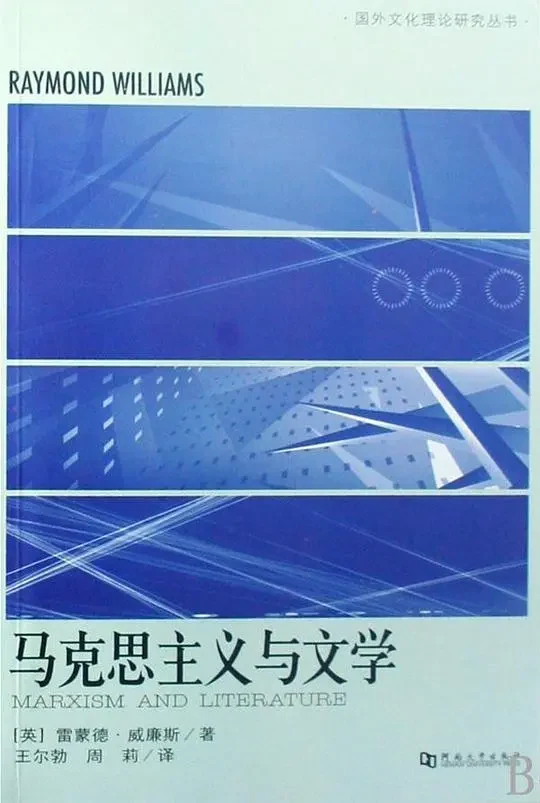
In Chapter 2 of Marxism and Literature, he has a fairly simple sentence explaining the structure of feeling. Let me read it as it appears in Chinese: "A structure of feeling can be defined as social experience in dissolving flux, defined as something sharply distinct from those already precipitated, more evidently visible, more directly available configurations of social meaning." But when I later looked at the original, I found that this translation basically leads people to misunderstand the "structure of feeling." Why? Rendering it as "social experience in dissolving flux" leaves people confused, and makes them think the structure of feeling is just some kind of flowing experience or collective feeling, which it isn't.
I went and looked it up specifically, and found that in the original Williams emphasized both the words corresponding to the Chinese "dissolving flux" and the word "precipitated." The original goes like this: "(For) structure of feeling can be defined as social experience in solution." He emphasizes "in solution." Translated literally, "in solution" means "in a liquid solution." So what the sentence actually means is that the structure of feeling is social experience in the state of a solution. Why do I say the next part is mistranslated too? Because Williams goes on to write "as distinct from other social semantic formations," that is, as distinguished from other social semantic formations. "Semantic formations" are semantic or pragmatic formations, not the "configurations of social meaning" of the Chinese translation. What are these "semantic formations" he's talking about? There's a clause after it: "which have been precipitated," that is, things that have already "settled out." Films, literary works, artistic movements—all of these are things that have settled out. The structure of feeling is different from them, because it's "social experience in solution." That is, you can imagine that at this point the solute and the solvent can no longer be told apart, which is why it has become a solution. The precipitates that haven't dissolved are literature, culture, these objects that have already been encoded. And what has dissolved is this ubiquitous feeling—to put it more evocatively, "atmosphere," what you sense in the air.
I think that whether it's fatigue, exhaustion, or anything else of the sort, it seems to have become a structure of feeling shared by all of us and still in the process of forming. Right now you can only grasp it by way of "feeling," not analyze it the way you'd analyze "precipitates" such as works of literature and art. Williams later asks: if the structure of feeling is this sort of thing, how should we analyze it? I think his answer is that you have to grasp it the way you'd sense the taste, temperature, and texture of a solution. That's why, even in your leisure time, when you throw yourself into other activities, you still feel this problem. Because you are a subject that is being affected and that affects (a being that affects and is affected). Looking at weariness and the way out of it in this light, I think we get a new answer.
My idea is this: if you accept that "affect" exists, and accept that it asks you to pay attention to the "solutions" that surround, envelop, even cling to your everyday life—not yet settled, still forming—those abscesses, lumps, extra and leftover things, then you'll find that every object you deal with in life is an object that triggers affect in you. It moves you first of all at the level of affect. Take music. When we listen to music, especially live, the various intensities we feel don't come from the lyrics or the melody. So in a sense, lyric studies really has nothing to do with music itself. To take my own experience: I like going to hear live music, and the reason is that there are usually huge line-array speakers hung on either side, and when you stand under them listening to the musicians on stage, especially when the drums kick in, you feel your chest vibrate along with it. That's a very obvious resonance, a transmission of intensity. And at live shows we also see ritualistic behavior at rock festivals, like pogoing and headbanging, people with their arms around each other's shoulders slamming into each other to the beat. These too are, first of all, apparatuses that trigger affect.
In this way, you'll find that if we want to find a way out of weariness, its opposite is certainly not leisure, but something more like the classical leisure Professor Qiu first mentioned—or, you might say, a kind of "multiplicity" and "wholeness." Because this means you can rebuild the connections between you and the objects of your desire in your life by seeking out new objects that trigger affect in you. Before, I thought—or was led to think—that some particular thing was important to me. But in fact, through popular culture or everyday life, you can find many ways in your life to rebuild your connections with the world and with others on the basis of affect. For example, our sitting here now, listening to me talk about such an abstract topic, is itself a new connection, a very immediate way of opening up multiplicity in your life. Or you go listen to pop music, or like a band, or become a fan of some star. Say I like the rock band Nirvana and think they're amazing; I might take up an instrument because of them. Once I've learned an instrument, I might get chances to perform, and gain some fans. Or even if I just listen to the songs, when I see someone on the street wearing a T-shirt of a band I like, even if I don't necessarily go up and say hello, won't I feel something I didn't feel before I got into that band? I think you might feel a little secret thrill. When you're a fan and run into someone who's a fan of the same idol, whoever they are, you get a new sense of richness.
What can this bring? Even if we're still in a disciplinary society and have no power to change this overall framework—and Han keeps demanding an overall program—we can still build new collectives in this way. It amounts to this: first you have to realize that our lives are a dynamic, flowing network, and then we try to find new connections and ways of becoming within that network, and so return to everyday life. So the fundamental way out is not to flee life, to escape to somewhere else or some other job, but precisely to come back and immerse ourselves again in our present everyday life, to look for new connections. Even if a connection is temporary, it will still fill a minute, an hour, or even longer of your life. And in the process, you may find the vocation you'll work for tirelessly all your life.
So you could call this a kind of micropolitics. As for whether we can have a better collective future, I think that can't be promised. Because neither affect nor any of the things we've been discussing will ever guarantee a better future. What we should be thinking about shouldn't be "Will doing this make us better?" Because you'll find that many grand narratives in intellectual history that claimed "just do what I say and everyone will have a better future" ended up leading people into catastrophe. So this is only a provisional program. It's hard to call it salvation, but at least it can let your everyday life show more facets and a more fluid state, and so enrich your own experience.
Sorry for talking so long; I wanted to lay out the chain of reasoning as completely as I could.
5. Returning to Everyday Life: Reshaping Connection Through Encounter and Ritual
Audience Member 4: Sorry to interrupt, but if I don't ask now I'll forget. I feel like I've just eaten a very fancy molecular-gastronomy meal without knowing what I ate. Because I don't really follow when you all talk about Kafka, Jung, and so on; what I know of them is limited to what's been said in the last hour. I've been trying to figure out what exactly you were saying just now, so I'd like to give an example of my own and see whether you could explain your view through it, so that I can understand better.
The way I feel is that I'm facing a lot of mirrors: my grades, my performance at work, how I come across online, and so on. These mirrors all reflect me, and between the self I identify with inside and the third-person me reflected in the mirrors, there's always an unbridgeable gap. That's what makes me feel so burned out. So I got rid of these mirrors, gave up my career, quit my job and went home, hardly went out, and tried to do whatever I wanted in a very relaxed state, or do nothing at all. The environment I was in seemed to make no demands at all; no one around me had any expectations of me in any of my roles: "You can have a career or not, you can succeed or not, you can have kids or not, it's all fine, you're already great as you are." When I was in that environment, it was like rowing a little boat and not seeing any coastline, and instead of feeling relaxed I became even more pressed. With no mirrors and no demands, I went back to that burned-out state. Because it was me pushing myself; I was very tense, very constricted. So I wonder whether there just isn't any ideal path out of burnout, and whether we should instead adapt to it, and enjoy the tension of looking for gaps of leisure while under burnout.
Guosen Chen: Here's how I see it. It isn't necessarily that you walk smoothly out of burnout into another state you could call leisure and then the burnout disappears. Because, as you just said, you escape from your old order of life into another one that seems to make no demands at all, and you still end up sliding into weariness, and this weariness may even make you doubt yourself more. Before, you may have been busy and felt weary, but at least you had some income, financial or otherwise; now you ask yourself, what do I actually want? So what I'm saying is that the way out, or the program, isn't choosing between A and B, nor is it a matter of how to get from A to B. Rather, we can imagine life as a layered pastry with many layers. In that case, fighting off or dissolving weariness is in some sense indeed impossible. Because, as you said, the gap is always there: between your self and the person you want to become, the things you want to do—like the mirrors you described—that gap exists. That's the Levinasian weariness we were just discussing; the so-called "curse" can't be escaped. But does being unable to escape it really mean I have to stay trapped in it? I don't think so. What I was saying is precisely that we become aware of its existence, and aware that it's precisely because those mirrors exist that we start to act, start to fill up the moments in all sorts of ways, whatever our emotions. But at the same time, what I keep saying is to build connections, to try to connect with anything else, rather than focusing only on myself or escaping into another order. You'll find that once you cut off your connections with other things, you may well still slide into weariness. There's a question of intensity here.
Audience Member 4: I have another question. I feel I lack a kind of... like the festival or ritual that professor mentioned; I really lack a state of pausing the self. These days there's so much emphasis on independent reflection, thinking for yourself; this autonomous consciousness is very strong, but I lack the state of pausing the self, so it's hard for me to merge into a larger collective, set aside some self-consciousness for a while, and enjoy the experience of merging into a larger consciousness. Those opportunities are fewer. So maybe I know that doing this could relieve some of my burnout, but I still lack the ability or the motivation.
Guosen Chen: Actually I feel that an exchange or conversation like the one we're having now is also a ritual, and for me at least it's become entirely one of the many facets of my everyday life. As for what you said about finding it hard to merge into a collective, I find it hard too. When I go to music festivals or shows, I always stand in the back row. When I see people pogoing and opening up a wall of death, I feel deeply uncomfortable, so I back away and stand far off and listen by myself. My ideal is to have nobody around me, just me listening, with a crowd in front of me doing who knows what, none of it having anything to do with me. But that doesn't mean you haven't made a connection. I think at least I don't demand of myself that I be like the audience there, or that I have to be like that to count as having merged with them. Because I'm standing here, listening to the same music they are, and I'm really feeling the same vibration they are; I really feel, because of this music, something hard to put into words but of very high intensity, and that's already enough to make up—yes, enough to make up the condition for "I feel I belong to some community" or "I feel I really am together with everyone." It takes many forms. For me, anyway.
Audience Member 4: But I always feel I lack that ability; I can only watch, I can't really take part.
Audience Member 3: I'd like to add that a so-called festival is really a sacred moment, and in everyday life you can create a so-called sacred time or space for yourself. For instance, when you go to a concert, from the moment it starts you may actually form a whole together with everyone and start enjoying it, and you can put everything else behind you for a while. And sacred spaces—say you go to a live house or a temple—it's like that feeling of "once you step through this gate, the dusty world has nothing to do with you." As long as you go into some place and do what you've chosen, what you like, and make it your way of resting, then whether as a stretch of sacred time or a stretch of sacred space, it may help you wall off the things that make you weary. And about the mirrors you mentioned: I don't think you need to escape them, smash them, not keep a single one. In fact you can have more mirrors—go find five or ten more. This is a bit like what Xiang Biao calls building your own "nearby." Take your weariness: I know for many people it comes from work, and maybe the mirror of work reflects a very weary you. But if you have other facets in your other hobbies or interests or life—say you have very good friends, or you're great at badminton, or you're a terrific fisherman, or you're really good at finding good food—these can all become more mirrors, and you can set up things that keep you from being weary.
Audience Member 4: My weariness doesn't come from my body, but from the first-person self and the third-person self being unable to reconcile; there's always a gap between them, but I don't accept that state, so I'm always trying to reach the self that's ahead of me. The live houses, heavy metal, temples you mention—I just got back today from a traditional academy, and I've deliberately gone to many ritual occasions like that, wanting to resonate, to pause the self, but I can't merge in. So I feel I may lack certain abilities or the motivation.
Xiaolin Qiu: I think it seems to be because of a state of not accepting, of not having accepted...
Yiqun Wang: Yes, even Oblomov lives better than we do.
Jingyuan: Hello, professors, and thank you to the host. I have three questions, which I think correspond respectively to the questions the two women just raised and to a question the professors discussed. I'll take them out of order. The first question goes like this. When I arrived I talked with Professor Wang, and you're also a fan of the film Blade Runner, so I'll start from there. In Blade Runner there's something called "Mercerism." You probably remember: in that future era, humans and androids coexist, and humans don't know what their existence as humans amounts to, so they have something called an "empathy box" to distinguish humans from androids. If you can empathize with a religious scene—an old man being attacked and suffering as he climbs a hill—then you gain a human sense of redemption. This became the spiritual pillar many people lived by at the time.

"Connection" came up many times in our discussion, and that made me think of this. Mercerism is one example. Things like religion, or our traditional family relationships—in an era when means of communication weren't so developed and it was easier for people to socialize, we had many means of connection. They let people, in sharing a condition of suffering, establish or see themselves as "human," rather than, as when we look into the mirror of work in the workplace, feeling ourselves to be "things," bearing a consciousness that doesn't let me exist as a person but only as a thing. So I want to ask: is the feeling of weariness a result of the objective decline in avenues of connection—for instance, the weakening of religion's intensity or the rise of social isolation? That's my first question.
Guosen Chen: Professor Wang, would you respond?
Yiqun Wang: Right, you mentioned the empathy box. I think that, as a test for determining who is a robot, it may be an optional, makeshift tool. But its fundamental problem, as you said, is that it completely dissolves the existential context in which we sympathize with a person. Sympathy has limits of distance—geographical distance, kinship distance. Often we even sympathize more with fictional characters than with real people. You can't make a judgment on the basis of an emotional reaction stirred up by such an abrupt scene. In some ways it's a simplification of people's living feeling of sympathy. This actually bears on whether the channels through which we contact the world and others in contemporary life have decreased. I think to some extent they have.
A few days ago I was rereading an essay on "nostalgia" by my teacher, Mr. Wu Xingming, in which he talks about his own life experience, or rather the abstractness and emptiness of modern people's life experience. I think in the digital age modern lives inevitably have this sense of abstraction, to varying degrees. Some people use the concept of "the age of deep mediatization" to describe the context that produces this sense of abstraction: even when we're face to face, we still have to cancel the face-to-face. Living scenes of face-to-face interaction are shrinking. For example, when we order at a restaurant, nobody needs to bring over a menu; you just scan a code. When we take a ride-hail car, we don't need to talk to the driver; we can adjust the air conditioning ourselves.
A while ago I was running on a treadmill at the gym and watching a film to pass the time. It was Kurosawa's The Hidden Fortress, in which a few people disguise themselves to escape their pursuers and stumble into a village bonfire festival. The festival is probably connected with some holiday commemorating farm work; people light a huge bonfire in an open field and sing and dance. One line from the song made a deep impression: "The life of a man, burned with the fire; the life of a bug, thrown into the fire. The more you think, the darker this world appears. This floating life is but a dream—so go mad!" Maybe because your mind goes especially blank when you're running, things move you more easily. It suddenly struck me that this is a deep, full experience of existence that's very hard to find nowadays. You don't have to become a hero or do heroic deeds; even if you live your whole life in obscurity, as long as you live in this world every day, you really are in the midst of the world and not outside of life. Your everyday life, to borrow an image, is like a tractor plowing through life. And looking at my own life, it really does seem abstract. Many of the questions I think about are abstract and remote, and some of the people I care about are fictional characters in films or literature. When I ask myself what scenes have moved me most lately, they're scenes from novels, scenes from films. Of course, I personally have the problem a friend mentioned just now: much of the time it's hard for me to fit into certain settings. For instance, I very rarely go to rock shows; maybe I'm a bit socially anxious.
Xiaolin Qiu: I'm socially anxious too.
Yiqun Wang: But that experience is real. The abstractness of life, as Guosen mentioned, I think calls for as much living contact and face-to-face conversation as possible, not just ways of amusing yourself alone...
Guosen Chen: It doesn't have to be people, either; anything non-human will do. Liking robots is fine. A while ago I saw a kind of bionic robot, a very cute little desktop robot that has emotional reactions; if you poke it, it responds. I really wanted one at the time, but it was a bit expensive, so I passed. So yes, entirely possible. You had a second question.
Jingyuan: Yes. But first I want to follow up on what you said, Professor. While you were talking, it suddenly occurred to me that we can't immerse ourselves in some fragmentary scene, can't merge into some rock show, as that friend (Audience Member 4) also mentioned. It suddenly occurred to me that perhaps we've overlooked the role "change" plays in producing weariness. Much of the time now we get wrapped up in some scene and then are immediately pulled out of it again; the feeling is temporary, like our fragmented information feeds. We watch a live show, then immediately leave and go back somewhere else.
In our discussion of leisure just now, there seemed at one point to be a sense of "long-termism," that is, persisting in building some meaningful project. I think this could give that friend some inspiration. When I myself went through a state of extreme confusion and extreme weariness, I also tried leaving, letting myself fall into some kind of leisure. But what later saved me was running. I got up and ran every day, and the aim was simply to be able to run again the next day. In this day-after-day persistence, after a hundred-odd days, I suddenly felt I was really something. That gave me a pillar and the courage to go on trying other things, and gave me time and experience of being alone with myself. I think in resisting weariness, we might look for ways to resist change.
Now my second question. The overlapping of self and oneself, or the subject's active design of leisure—whether based on interests, meaningful projects, or so-called freedom—actually carries a lot of pressure. An occasional shift of attention may bring us comfort, but if we demand a long-term, independent leisure that we take on actively ourselves, we'll find that much of the time we're avoiding this sense of harmony, avoiding a healthy way of living. My friends and I joke after work that "running is shameful, the nightclub is glorious." I feel that much of the time being unable to shake off weariness, or refusing to build a sense of humor, is linked to some unspeakable fear behind it. This fear isn't just about feeling utilitarian pressure or a threat to survival; it's a lack of confidence, as if I've actively chosen a kind of "learned helplessness." The point raised earlier, that "the emotional intensity felt in sadness is stronger than in the happy film," led me to a further thought: that people may sometimes wallow in an emotional state, including weariness. When I'm a weary person, I myself become a powerful piece of evidence for condemning society, and I can't bear to pull myself out of this lack of confidence. That's my second question; I'm not sure whether it counts as a question.
Guosen Chen: Professor Qiu, would you like to take this?
Xiaolin Qiu: I may not have quite followed...
Audience Member 5: About depression, there's a view that patients actively choose to be depressed, that they themselves don't want to come out of it and wallow in it.
Xiaolin Qiu: If they find it comfortable, that's fine too.
Audience Member 5: Right, I've just heard there's such a view...
Guosen Chen: The other day I watched a blogger talking about unhealthy lifestyles. I really like him; his Bilibili account is called "Slacker's Office." Mr. Slacker says, "Does the joy of staying up late really need explaining?" An unhealthy life is the happiest kind.


Xiaolin Qiu: That's roughly the relationship. On this question, let me bring up Jung's way of treating patients again. If a patient—what he calls a patient isn't necessarily a patient—was determined to kill himself, Jung wouldn't stop him; he would let him do it. Some people would call that immoral, a refusal to intervene. But he said he didn't intervene; he let the person concerned make the choice. I think it depends on how you see "healthy" and "suitable." Like that friend (Audience Member 4) just now: halfway through what she said, I envied her that comfortable state of non-doing, but then she shrank back, and in that state she wasn't comfortable anymore. I think your first comfortable state came from temporarily breaking free of a ritual or a mirror image you didn't like, which may have been compulsive. Once you'd broken free, what you needed was to go on and build rituals you do like, but you didn't build them, and that may be where the problem lies.
Why talk about the word "ritual"? What ritual means is that its significance for life isn't ultimate, and there's no truth to be had in it. Jung thought the problem now is that people don't live a symbolic life—to put it plainly, they don't live a ritual life—and it doesn't matter which ritual you choose. For example, he especially valued his exchanges with American Indians. Some of them said the meaning of their life was to help the sun rise every day. They truly felt they were helping the sun laboriously rise; they did it every day, spent most of their lives doing it. Then Jung says, someone might ask, didn't God create the sun? And the Indians wouldn't have it; there was nothing behind the sun, the sun was ultimate, and their life was to help the sun rise. And Jung says this is very good, this is living a symbolic life. He also noticed that Catholics rarely have neuroses, while Protestants have more, because Protestants have relatively less ritual life. So he thought we should live a symbolic life, which is really a ritual life, whatever the ritual. So what's the key here? You just need to find your ritual, but don't think it's the truth, because there is no truth in it; each person just needs to find the ritual that suits them. You can believe in anything. Someone put a very pointed question to him: what about those who believe in Nazism? His answer was rather oblique. I think he may have been answering on the spot and his mind didn't turn fast enough, so his answer wasn't very full. If I were to answer, after some thought, I'd say that although we say there is no truth in your choice of ritual and it's arbitrary, there still have to be some ethical preconditions, namely not harming others. I think that's quite important.
Audience Member 4: But the balance is hard to strike: on the one hand you're supposed to emphasize the self, on the other you're supposed to let go of part of the self and merge into some larger state of consciousness.
Xiaolin Qiu: The question is, why do you need an ontological self?
Audience Member 4: Because in this society, if you don't keep some self and some independent thinking, it's very dangerous.
Xiaolin Qiu: Right, so having that awareness is enough. But if you're genuinely willing to give yourself to a ritual, I think if it puts your mind at ease, that's enough. Didn't I mention Pieper's book earlier? He thinks the reason we have no leisure now is that we have no religious life.
Let me read you a passage in which Jung records meeting an American; I find it quite moving. He talks about those people who travel all over the world looking for something, and meet him. He first talks about the Indians I just mentioned, and then he goes on: "You see, you Americans, these restless travelers are always seeking something, always vainly hoping to discover something. On many of my travels I've met people on their third uninterrupted trip around the world—always traveling, always seeking. In Central Africa I met a woman, and a man driving from Cape Town to Cairo. I asked him: 'What are you going to Cairo for? Why are you going to all this trouble?' When I looked into his eyes I was startled; they were the eyes of a hunted, cornered animal. Seeking, always seeking something. I said: 'What are you looking for in this world? What are you waiting for, what are you chasing?' He was as if possessed; he had been seized by the demon pursuing him. Why was he seized? Because he hadn't lived a meaningful life; he lived a rather mediocre, impoverished, boring life, without any meaning at all. If he were killed today, nothing would happen, nothing would disappear, because he is insignificant. But if he could say: 'I am the daughter of the moon; every night I help Mother Moon rise above the horizon.'" Jung doesn't say, as if handing us the truth, "this meaningless life of ours must go in search of an ultimate truth"; instead he gives the example of the Indian. I find that quite wise, a wise way of putting it. I've always thought that life is about finding rituals, finding your own rituals. Unfortunately the vast majority of people, myself included, haven't found a really comfortable ritual.
Guosen Chen: Besides ritual, I think there's another especially important keyword for life, and that's "encounter." Because with any encounter, you realize it will surely bring something beyond the part that can be conceptualized. For instance, after you meet someone, or have some contact with a cat, you can always say part of it—how things went with that person, or what happened. But what really makes up our own lives, or rather, what is left over in the end, over the long run, from all these encounters? For me, it's precisely that excess, the something extra, outside the circle of what I can put into words. For example, if we think back to the classes we had as children, you certainly can't remember anything the teacher said, but what's stuck in your head might be that it was a very hot day, or that the teacher had a slightly odd way of talking, or that your deskmate did some very strange thing. But during class you were supposedly listening to the teacher teach you things. So if we keep this awareness—in life's encounters, paying more attention to the remainder, the extra, beyond the part we can conceptualize—I think it will make your senses a little sharper. This has nothing to do with self or not-self, at least in this sense. Thank you.
Yang Liu: Professor, I'd like to add something. I'm an architect, I deal with things at the level of space, and I've been thinking... I'm actually someone who doesn't get burned out at all. I'm very busy at work—I might write a dozen or more papers a year—but my classmates and teachers around me are very weary. I'm curious why I don't feel tired and they do, so I can share my experience with everyone.
I think there are three levels. The first is space. I think the design or perception of space is closely tied to people's sense of weariness. When I choose a space to work or do things in, I always choose one with less discipline. I try not to work in my studio or office; I work at home, because at home I can write papers very casually—I can write for a bit, then play guitar or piano for a while—but in my studio I can't, because my doctoral adviser keeps an eye on me, or he'll scold me if I play the piano. A place away from discipline like that is, I think, very important. But back to the topic: most people don't actually have an environment as free as ours, as graduate students. What Fei Xiaotong describes in From the Soil is a society of settlement relations, where the whole space is actually fairly free; you can go play and so on. But now, urban space is highly divided by function, very clear-cut; you go from home to work and back home, a few fixed points, with no space where you can move about freely, no loosely organized space. I think the next step, for architects and planners as well as for those of us who work, is to look for these kinds of spaces of rest, which is very important.
The second thing I think can solve the problem of burnout is the aesthetic. Even though I studied art or architectural design, I've found that most of my friends aren't actually sensitive to the aesthetic, whether in music or anything else. Like the rock music Mr. Guosen mentioned—most of them aren't interested; put on some heavy metal and they'll probably find it noisy. They don't have that aesthetic capacity. Whether you have aesthetic capacity is, I think, a key point in deconstructing burnout. Because I make music myself, and I've found that when I'm writing songs or playing an instrument, my weariness disappears very quickly. So I think the aesthetic is also a way of solving burnout. When I look at some Chinese landscape painting or read classical literature, I relax a lot. A friend of mine, also from the Sichuan University College of Arts, does research in neuroaesthetics, and found through experiments that different students looking at the same landscape painting show different degrees of fluctuation in their brainwaves. That is, aesthetic imagery can ease the tension in your nerves. I think training in the aesthetic is also one way of solving burnout.
The third thing I'd like to share is a kind of pluralism of ideology. For example, when I was studying at Sichuan University, I basically never went to class as a graduate student, or was late every day. I didn't really care whether the teacher took attendance; I deconstructed his rules. Applied to rock music, this is something like the punk spirit. I think this pluralism of ideology or values is also a way of deconstructing discipline, or burnout. Those are the three points I wanted to share.
Audience Member 5: Thank you. It feels like the burnout and weariness we're talking about sometimes mean the same thing and sometimes don't. And what you mean by not being burned out is not feeling very tired.
Yang Liu: Right, I'm actually very busy at work, but I've never felt tired. I don't know why either.
Yiqun Wang: I think the first point is the most important. There are actually other sorts of people in the world: some people fret about getting off work at five every day, and some fret about not being able to get off at five (that's something Oblomov says).
Xiaolin Qiu: It's because you have control. Actually, the "burnout" and "weariness" we've been talking about later on have drifted apart a bit. You're saying you have the ability to write lots of papers and also to play guitar and piano, and you have aesthetic capacity. That's one side of it. But some people, even with all your abilities, are just as burned out; they find it all pointless—writing papers is pointless, scholarship is pointless.
Yang Liu: I find it pretty interesting.
Xiaolin Qiu: Like Onegin, or the people we see in Western literature living lives of luxury and dissipation, with far richer content than ours, but deeply sick of life.
Audience Member 5: Right, in the end the form may be the same, but you need a support of value.
Xiaolin Qiu: He's capable of doing it, but he feels it doesn't really have any value. That would...
Audience Member 5: Like religion, which we talked about: you need something to hold on to, to lean against, to prop yourself up, and only then do you feel there's value.
Xiaolin Qiu: I think "pan-religion" is a better term. Really, anything that's about finding a support of meaning, finding order, is a kind of religion.
Guosen Chen: Let's let her finish her third question first, and then we can talk. Thank you, sorry.
Jingyuan: Those were my two questions, but actually I think Professor Qiu has already answered the third. Let me say what I meant by my second question. It was that sometimes we lose the motivation and courage to find new connections in life, or to break out of the state of burnout. I think there are many possible explanations for this; it isn't necessarily that I'm already so burned out I can't break out, it could also be a kind of unfamiliarity. Take our exam-oriented education. If an important way of dealing with burnout is to construct your own intentionality, but our exam-oriented education has discouraged us from doing that since childhood, then actively building that kind of intentionality is unfamiliar to us. That's what I meant to say with my second question. And you've already answered the third. Let me just say what it was: is our perception of burnout due to our having formed an unshakable, fixed view of "continuation" itself? I wanted to raise this using Professor Qiu's own example of running 1,500 meters. I felt that for Professor Qiu, maybe the pain of the 1,500 meters came from a background: you felt you were on a racetrack, you felt that speed was the most indispensable part of running at that moment, and the scene of the racetrack further reinforced the equation between running and speed. This doesn't necessarily mean you felt pressure to win a prize; it's just how you felt at the time.
Xiaolin Qiu: My pressure was how to finish.
Audience Member 5: All right, but if you just had to finish, would you still feel burned out if you walked on the track?
Xiaolin Qiu: Same thing, because you have to get it done—that's the so-called ideal self.
Guosen Chen: Let me tell you about my own experience, because the last long run of my life was the 1,000-meter run in the physical fitness test when I was an undergraduate. During the run I stopped and walked for a stretch. When I stopped, I was in total despair, because I knew I'd have to start running again. And when I started running again, my body's weariness was sure to be stronger than before. Because running works like this: when you start, you get more and more tired, and after a certain point the weariness stops increasing. But I'd stopped partway, so I had to start over. When I felt that weariness the second time, it was utter despair. What I remember vividly is that my legs weren't my own, my lungs weren't my own; I was just mechanically putting one foot in front of the other.
Audience Member 2: I just want to add one thing. It reminds me of an idiom: "so happy doing it that you never tire." If you're happy, you won't get weary.
Yiqun Wang: These past two years I've tried some things that might be fun. For instance, I watched a friend play kendama and thought it was great fun, so I bought one, but after a few days I just set it aside. To have an interest you never tire of, something that stays with me all along, is a very rare thing. If, because life feels boring, you set out to rebuild interests, to look for interests, it may actually be hard to build them precisely because there's a purpose behind it.
Xiaolin Qiu: Let's aim for next time... maybe that can be done too. But perhaps the most fundamental weariness, the kind we're talking about today, is what Guosen described: it really is a social affect. As soon as you mention it, everyone knows what it means; it's a pervasive social mood, and it's at the level of one's whole sense of existence, not about one particular thing. Like when you don't want to write a paper or don't want to go to work, it's really about your whole life, not just that one thing; you may feel burned out doing many other things too. I think that's what's most fundamental.
Yiqun Wang: Like the nineteenth-century Russian disease of melancholy.
Guosen Chen: There's an argument that twentieth-century modern literature is basically the high point of the problem of burnout. Whether you read Kafka, or someone like Proust—you could call it a refined burnout, with money and leisure and a feeling that life holds no interest—or Joyce, who devotes chapter 16 of Ulysses to presenting this boredom and burnout: Bloom and Stephen pass by a shelter in the early hours of the morning, the dialogue between the two is extremely long-winded and dull, and the whole chapter is made of clichés. But if you really want to draw an equals sign, or a connection, between burnout and creation, that's a very frightening thing. It doesn't mean burnout can bring some better life. Because if you think burnout actually helps you produce better work, that's like thinking writers or painters can only create good work if they become madmen or martyrs. If this happens to you yourself, you're a masochist; if you want to extend it to others, you're a sadist. In a sense it's a deeply paradoxical thing.

But there is one rather special case here, at least a special case in the history of philosophy or literature, and that's Bartleby the scrivener. Giorgio Agamben wrote about Bartleby because he's someone who purely says "I would prefer not to." His boss asks him to do all sorts of things, and he just says "I would prefer not to"—a pure refusal. Agamben says that in such a refusal you can see something called "potentiality," which is what I talked about at the very beginning: a state of potential that hasn't yet had time to become actual, but that means it may very well become actual. Agamben defines Bartleby as the representative of such a power, a special negative power, a capacity to suspend action and keep oneself in a state of pure possibility, and then holds forth at great length. This is also something I read a long time ago; just adding a small note.
6. A Game Without an Ultimate: When Rituals and Interests Run Dry
Hui Xiang: The day before yesterday we had a science fiction writer come to give a talk, and he was quite interesting. Let me use his novel. The first half is roughly an esports story and the second half a science fiction story. The esports protagonist comes from a very poor family with some family-of-origin problems, but he discovers he has a special ability. When he plays games... a lot of games require you to operate very fast, or to react very sharply, and he finds he sometimes has these moves that come to him in a flash of inspiration. Later he discovers that this doesn't come from his consciousness at all, but from data in the cloud—something like a remainder of his consciousness; outside his consciousness there's another consciousness, or a kind of bodily sense. The first part is basically him using his ability to cheat in the game, and then in the second half he goes off to find out where the ability actually comes from. That's roughly the structure.
Because of that, it occurred to me: is the overall structure of a lot of what we've talked about today like a game, and doesn't a game itself run out? Whether it's match by match or a complete game, it always ends. But people have found another kind of game, which is to keep a game going—say there's a big tournament every year, with different modes and rotating heroes—and then people never tire of it. But my own sense is—someone mentioned earlier the idea that if you do what you like, there's no weariness—I think that's impossible. If you play games a lot, you'll find that as long as you keep playing that game, there will certainly be a feeling, a moment, of weariness. You may regain that passion, but you may also lose it forever.
So I think the interests, pastimes, or consumption people have mentioned actually have a structure somewhat similar to games. For instance, as a consumer you listen to a rap track, and when it's over it's over; that's basically the end of it. You may have something left over, but all that does is keep you listening, or going to music festivals and such; you'll treat it as a ritual, as repetition. But repetition doesn't guarantee that its meaning and its affect will keep appearing. Isn't that a pretty hard problem? That is, first, rituals or games may burst forth with meaning, but this too is probabilistic, contingent. And what keeps the system turning seems to be only repetition or upgrading, but that can't guarantee that meaning will appear either.
Xiaolin Qiu: I think it's like this. If we're a little clear-headed, we know there is no ultimate game; there's no ultimate essence or truth in it. So we're all choosing, but whatever game we choose, there really is a time when the enthusiasm runs out, interests included. So I think that as for burnout, all we can do now is accept it with equanimity; it's a condition in our lives that by now is basically inescapable. And the solution can only be personal; a one-size-fits-all package is impossible. For any thinker to propose an all-in-one overall program—that's impossible. It can only be personal.
Guosen Chen: What Professor Qiu just said reminds me of Henri Lefebvre's concept of the "moment." It's a bit like what Hui Xiang described: you can see it as an instant in everyday life that can bring about a new turn or rupture in life. But this instant isn't necessarily liberation; it may make life worse. It's a moment that may lead to a new turn or may bring a new alienation. But for Lefebvre, the task of the critique of everyday life is to keep discovering these moments and seize them. Because, when all is said and done, if you don't seize them, you won't even have the chance of a turn.
And for him, everyday life has this structure: imagine a patch of soil with flowers growing out of it. Every day we do some repetitive activities and some specialized ones. For him, everyday life is what settles into the soil after the tree or flower has shed its leaves and dropped its fruit—the remainder. That's everyday life. Although by definition everyday life is what remains once the higher, specialized activities are excluded, the process can be called cyclical, and cyclical doesn't mean repetitive. Your leaves grow, fall, rot away, return to the soil, and then grow again. That's the structure of everyday life in Lefebvre's sense, and I find it quite illuminating.
Yiqun Wang: I'm now thinking that being alive every day is really a very complicated business.
Guosen Chen: But you have no choice but to live, because a lot of the time you can't stop.
Audience Member 2: Could it be that burnout just isn't a problem, and it's because we think too much? A farmer who works the land every day and doesn't think so much may be much happier than we are.
Yiqun Wang: But is a life without inner tangles still a life?
Guosen Chen: But a farmer's sorrow or happiness isn't something we can put on a scale and compare with ours. What I mean is, his suffering may be all he can bear; for him there is nothing more real or authentic than that experience, so naturally there's no such thing as "happier than us" or "more miserable than us." Even if it's about ten yuan, a hundred yuan, or the harvest, and so on.
Yiqun Wang: I think it's like this. In everyday life we're actually immersed in living; we don't step outside life itself to look back at it. But we always do step outside eventually, to think about what we've actually been doing. I may not notice burnout, but I'll notice some aspects of life. For instance, I met someone I don't like—why didn't I leave right away? Why did I end up spending several hours with him instead? Why do I do that? Maybe each person focuses on different things. No one stays submerged in the stream of life forever without making some reflective observation of it.
Yanzhen: I'd like to ask the professors: look, say you get a bit burned out doing something, so you move upstream in the supply chain and go burn out other people. Say you get burned out running a bookstore, so you go into publishing. You get burned out on publishing, so you go write books. Do you think that's how it works?
Xiaolin Qiu: That's great; if you're able to, of course it's great.
Audience Member 7: Because when you're downstream, you're disciplined by those upstream.
Xiaolin Qiu: The key is the burnout that can't be resolved, the sense of nothingness that pervades your whole life.
Audience Member 7: The key is the sense of nothingness. Depends on how you understand it. You can do things one stage at a time, find rituals that let you escape for a while, dodge from one stop to the next, but you can't resolve the ultimate sense of nothingness.
Xiaolin Qiu: To resolve the burnout that comes from the sense of nothingness, you'd probably need Buddhism, you'd need religion. But you're still back to what you said: the thing goes round and round.
Guosen Chen: All right, if no one has any other questions—I see we're coming up on two and a half hours. Thank you all. Our long-winded chat may not have helped ease anyone's burnout, and may even have made it worse. Let's stop here for today.